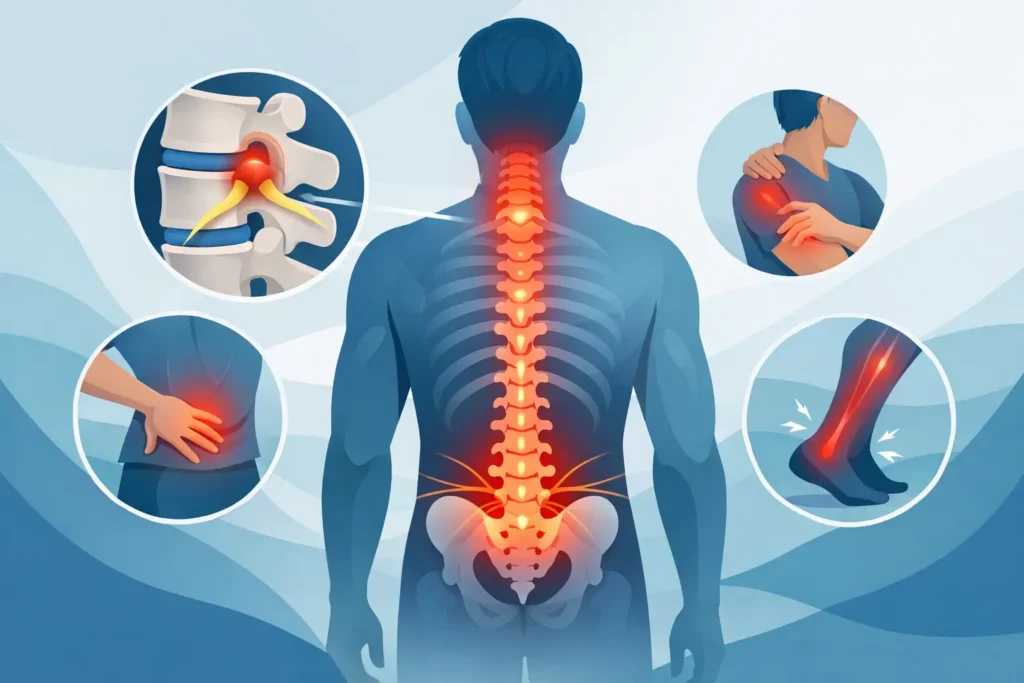
A nerve can be irritated long before pain becomes unbearable. The top signs of spinal nerve compression often begin as a pattern that feels easy to dismiss: tingling in one hand, a burning line down one leg, a foot that starts catching on the ground, or neck pain that suddenly changes how far you can turn your head. These symptoms deserve a careful clinical evaluation, particularly after a car accident, a lifting injury, or a period of worsening back or neck pain.
Spinal nerve compression occurs when pressure or inflammation affects a nerve root as it leaves the spine. A disc bulge, disc herniation, arthritic joint changes, spinal narrowing, swelling after injury, or muscle and soft-tissue dysfunction may contribute. The exact symptom pattern depends on which nerve is involved and how significantly it is affected. Pain alone does not tell the whole story. Changes in sensation, strength, coordination, and daily function often provide more useful diagnostic clues.
1. Pain That Travels Beyond the Neck or Back
Localized soreness is common with muscle strain, but compressed or irritated nerves frequently create pain that travels. In the neck, discomfort may run into the shoulder blade, shoulder, arm, forearm, or fingers. In the lower back, it may extend into the buttock, hip, thigh, calf, ankle, or foot. This lower-body pattern is commonly called sciatica.
Nerve-related pain can feel sharp, electric, burning, shooting, or unusually deep. Some patients describe it as a sudden jolt when they cough, sneeze, bend, sit, or look in a particular direction. Others feel a steady ache with intermittent flares. The distribution matters: pain that repeatedly follows the same path is more suggestive of nerve involvement than a generalized ache that moves unpredictably.
2. Numbness, Tingling, or Altered Sensation
Pins-and-needles sensations are not always caused by poor circulation. When a spinal nerve is irritated, the brain may receive altered sensory signals from the area served by that nerve. A patient may notice fingers that feel asleep, a numb patch on the outer calf, tingling in the toes, or a strange burning sensation without visible skin changes.
Symptoms may be intermittent at first. For example, sitting may cause leg tingling that improves after walking, or sleeping with the neck turned may produce numbness in an arm. Recurrent symptoms should not be ignored simply because they resolve temporarily. Position-dependent symptoms can offer valuable information during a neuromusculoskeletal examination.
3. Muscle Weakness or a Loss of Grip
Weakness is one of the more significant signs of spinal nerve compression because nerves control muscle activation. It may be subtle before it becomes obvious. You might find that a coffee cup feels less secure in one hand, opening jars has become harder, a knee gives way on stairs, or one foot seems less responsive when climbing a curb.
In the cervical spine, nerve compression may affect shoulder, arm, hand, or grip strength. In the lumbar spine, it may affect hip movement, knee extension, ankle control, or the ability to raise the front of the foot. Weakness can also change how you compensate during work, exercise, driving, or household tasks, placing added strain on other joints and muscles.
Not every feeling of weakness is a true neurologic deficit. Pain can inhibit movement, fatigue can reduce performance, and certain shoulder or hip conditions can imitate nerve symptoms. That is why a focused examination of reflexes, sensation, muscle strength, range of motion, and movement patterns is more reliable than self-diagnosis.
4. Balance Problems, Clumsiness, or Changes in Walking
Nerve compression can affect coordination as well as pain. A person may begin dropping items, struggling with buttons, feeling unsteady when walking, or noticing that one leg does not move normally. A foot that slaps the floor or catches unexpectedly can indicate reduced control of the muscles that lift the foot.
Balance changes have many possible causes, including inner-ear problems, medications, joint disease, and neurologic conditions outside the spine. Still, when clumsiness or gait changes occur with neck pain, back pain, radiating pain, numbness, or weakness, spinal involvement should be considered promptly. A detailed diagnostic evaluation helps determine whether the issue is related to a nerve root, the spinal cord, peripheral nerve irritation, or another cause.
5. Symptoms That Worsen With Specific Positions or Activities
Mechanical patterns are common in spinal conditions. Prolonged sitting may increase low-back pressure and leg symptoms. Looking down at a phone, working at a computer, or turning the head while driving may trigger neck-to-arm pain. Bending, twisting, lifting, coughing, or standing for long periods can also make symptoms more noticeable.
This does not mean every position-sensitive symptom is a compressed nerve. However, a consistent relationship between movement and radiating symptoms is clinically meaningful. It can help identify the structures involved and guide a treatment plan that addresses both nerve irritation and the mechanical dysfunction contributing to it.
6. Headaches With Neck Pain or Arm Symptoms
Certain headaches are connected to cervical spine dysfunction. When neck joints, discs, muscles, and nerves are irritated, pain may begin at the base of the skull and refer toward the head, temple, or behind the eye. After whiplash or another auto accident injury, this pattern may occur alongside restricted neck motion, shoulder tension, dizziness, or arm tingling.
Headaches have many causes, and a headache should not automatically be attributed to the neck. Sudden, severe, unusual, or rapidly worsening headaches require urgent medical attention. But recurring headaches paired with neck stiffness and neurologic symptoms warrant an evaluation that looks beyond temporary symptom suppression.
7. Symptoms That Do Not Improve as Expected
A minor strain often begins to improve with appropriate rest, activity modification, and time. Nerve compression symptoms may persist, recur, or gradually spread despite those measures. Medication may dull pain while numbness, weakness, or restricted movement continues underneath. That difference matters because reduced pain is not always the same as restored function.
Persistent symptoms are particularly important after a collision. Adrenaline and soft-tissue inflammation can mask the full extent of an injury in the first days after an accident. A disc injury, joint dysfunction, or nerve irritation may become more apparent as swelling changes and normal activities resume. Early documentation and a thorough examination can clarify the injury pattern and support an appropriate care pathway.
When Spinal Nerve Compression Needs Urgent Care
Some symptoms require immediate medical attention rather than waiting for a routine appointment. Seek emergency care for new loss of bladder or bowel control, numbness in the groin or inner thighs, rapidly progressing weakness, inability to walk safely, severe trauma, or sudden symptoms affecting both arms or both legs. These can signal a serious neurologic condition that needs urgent assessment.
For non-emergency but persistent symptoms, a methodical evaluation is the next step. Imaging may be helpful in selected cases, but findings must be matched to the examination and the patient’s symptoms. Many adults have disc bulges or degenerative changes on imaging without pain, while another patient may have substantial symptoms from a smaller finding in a highly sensitive location. Effective care begins with identifying what is clinically relevant, not treating an image alone.
A More Complete Path Toward Relief
Non-surgical care may be appropriate for many forms of spinal nerve irritation, depending on the diagnosis, severity, and presence of neurologic deficits. A plan may include precise manual medicine, non-surgical orthopedic decompression, movement guidance, rehabilitation strategies, and coordination with medical specialists when needed. The goal is not simply to quiet symptoms for a few days. It is to reduce mechanical stress, improve mobility, protect nerve function, and help the patient return to daily life with greater confidence.
At Prather Neuromusculoskeletal Medicine, Dr. Eric J. Prather applies a diagnostics-driven approach to spine, joint, nerve, muscle, and soft-tissue conditions. If you are experiencing the top signs of spinal nerve compression, do not wait for a manageable symptom to become a limiting one. Schedule a Complimentary NeuroSpinal Case Review by calling 337-984-3113 or book online at www.prathernmm.com or www.louisianaringdinger.com. A clear diagnosis is often the first meaningful step toward safer movement and lasting relief.