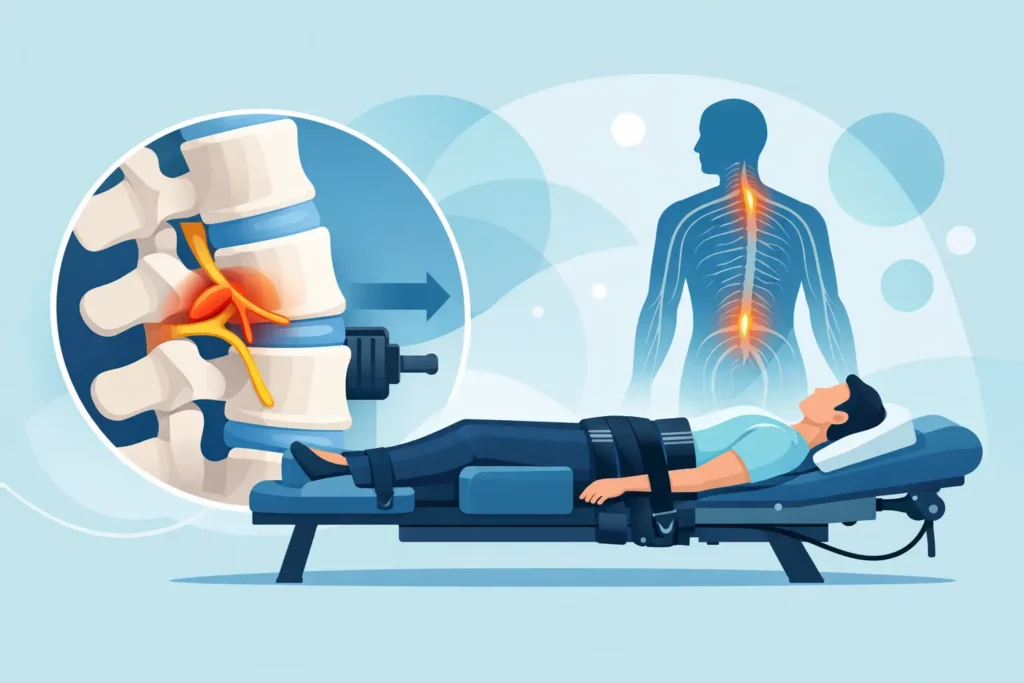
A pinched nerve can make an ordinary movement feel like a warning shot. Reaching for a seat belt may send pain into the arm. Standing after a long drive may trigger burning down the leg. So, can decompression help pinched nerves? For the right diagnosis, non-surgical orthopedic decompression may reduce mechanical stress around irritated spinal structures and help improve comfort, motion, and daily function. It is not the correct answer for every type of nerve pain, which is why a precise neuromusculoskeletal evaluation comes first.
What a “Pinched Nerve” Usually Means
“Pinched nerve” is a useful everyday term, but it does not identify the exact cause. In the neck, low back, or other regions of the spine, a nerve root may become irritated by a disc bulge, disc herniation, narrowing around the nerve opening, joint degeneration, swelling after an injury, or muscle guarding that changes normal movement patterns.
The symptoms can travel well beyond the spine. Cervical nerve irritation may cause neck pain with numbness, tingling, weakness, or aching into the shoulder, arm, or hand. Lumbar nerve irritation may produce low-back pain, sciatica, buttock pain, leg tingling, or weakness in the foot. After an auto accident, whiplash and soft-tissue injury can create inflammation and altered spinal mechanics that aggravate these symptoms.
Not every sensation that feels like nerve pain originates from a compressed spinal nerve. Peripheral nerve entrapment, hip or shoulder dysfunction, vascular concerns, and certain medical conditions can produce similar complaints. That distinction matters because treatment should address the source of the problem rather than merely chase the location of the symptoms.
How Non-Surgical Decompression May Help
Non-surgical orthopedic decompression uses controlled, progressive traction to gently distract a targeted spinal region. The goal is not to force the spine into position. It is to create a measured unloading effect that may reduce pressure on discs, facet joints, and tissues surrounding a nerve root.
When a disc-related problem is contributing to nerve irritation, this change in mechanical load may help some patients tolerate movement with less pain. By decreasing compressive forces and improving the environment around the affected segment, decompression may support fluid exchange within the disc and reduce protective muscle spasm. For someone whose sciatica worsens with sitting, bending, or prolonged standing, that reduction in irritation can be meaningful.
Decompression is typically most useful as part of a broader care plan, not as an isolated procedure. A clinically directed plan may also include manual medicine, targeted spinal manipulation when appropriate, mobility work, activity modification, and guidance on how to avoid repeatedly aggravating the injured area. The objective is improved function, not simply a temporary reduction in symptoms.
Can Decompression Help Pinched Nerves From a Disc Problem?
It can, particularly when the pattern of pain and diagnostic findings suggest disc involvement or spinal compression without an urgent surgical indication. Patients with a disc protrusion, disc bulge, or certain herniations may be candidates if their condition is stable and they can safely tolerate the treatment position and traction forces.
Response varies. A recent flare with inflammation may require a more conservative starting point than a chronic condition with stiffness and restricted motion. Some patients notice improvement in radiating pain early in care; others need a longer course before changes in mobility and tolerance become clear. A responsible recommendation should never promise that decompression will “fix” every disc or eliminate every symptom.
When Decompression May Not Be the Right Choice
Nerve symptoms deserve careful screening because the same word, “pinched,” can describe very different clinical situations. Decompression may be inappropriate or require medical clearance in the presence of spinal instability, fracture, severe osteoporosis, certain implanted devices, infection, tumor, or other significant conditions. Pregnancy, recent surgery, and complex medical history also call for individualized consideration.
Some symptoms require prompt medical attention rather than a routine decompression appointment. New or progressing muscle weakness, loss of bladder or bowel control, numbness in the groin or saddle region, fever with severe back pain, or severe pain after significant trauma should be evaluated urgently. These are not symptoms to wait out at home.
Even without emergency signs, persistent numbness, worsening weakness, or pain that has not responded to appropriate conservative care deserves a more thorough assessment. Advanced imaging or coordinated care with another medical specialist may be necessary. Non-surgical treatment and surgical consultation are not competing ideas when patient safety is the priority. The best pathway is the one that fits the diagnosis.
Why Diagnosis Changes the Treatment Plan
Two people can report identical leg pain while needing very different care. One may have an inflamed lumbar disc affecting a nerve root. Another may have hip dysfunction, sacroiliac joint irritation, peripheral nerve involvement, or pain referred from degenerative joints. Applying the same treatment to both would be guesswork.
At Prather Neuromusculoskeletal Medicine, the evaluation is designed to identify the biomechanical and neurological factors behind the complaint. This can include a detailed history, orthopedic and neurological examination, movement assessment, and imaging support when clinically indicated. Dr. Eric J. Prather’s board-certified Neuromusculoskeletal Medicine perspective focuses on whether decompression is appropriate, what spinal region should be addressed, and what other treatment may be needed for a complete plan.
This approach is especially valuable after an automobile collision. Symptoms from a crash may not fully appear until days later, and a cervical or lumbar sprain can coexist with disc injury, joint irritation, headaches, or nerve symptoms. A patient may feel pressure in the low back but have the most limiting complaint in the leg. Care should account for the full injury pattern, not just the loudest symptom.
What a Decompression Plan Can Look Like
A decompression plan begins with determining whether the patient is a candidate. If it is appropriate, treatment is generally delivered in a series of controlled sessions rather than a single visit. The settings and position are selected based on the affected region, symptom pattern, physical findings, and patient tolerance.
During treatment, patients usually remain clothed and are positioned comfortably on specialized equipment. Gentle traction cycles are applied with the aim of unloading the targeted spinal segment. The experience should not involve sharp pain, increasing numbness, or a sense that symptoms are being forced through. Any adverse response should be communicated immediately so the plan can be adjusted.
Outside the treatment room, the patient’s habits matter. Repeated bending, poor lifting mechanics, long periods of sitting, and premature return to strenuous activity can keep an irritated nerve sensitized. Conversely, carefully selected walking, mobility work, posture changes, and a gradual return to activity may help preserve gains between appointments. The details depend on whether the primary issue is cervical, lumbar, disc-related, post-traumatic, degenerative, or a combination.
Relief Is Meaningful, but Function Is the Better Measure
Pain reduction matters, especially when sleep, work, driving, and family life have been interrupted. Still, a stronger measure of progress is what the patient can do again. Can they sit through a meeting without leg pain? Turn their head while backing out of a driveway? Walk farther, sleep more comfortably, or return to exercise without symptoms traveling down an arm or leg?
Those functional markers help guide care decisions. If a patient is improving but still has limited strength or persistent neurological changes, the plan may need further testing or coordination with another provider. If symptoms are not changing as expected, it is appropriate to reconsider the diagnosis rather than continue the same intervention indefinitely.
If radiating pain, tingling, or restricted movement is affecting your life, a clear diagnosis is the most useful next step. Prather Neuromusculoskeletal Medicine offers a Complimentary NeuroSpinal Case Review to help determine whether non-surgical orthopedic decompression or another treatment pathway may fit your condition. Call 337-984-3113 to schedule and take a measured step toward moving with greater confidence.