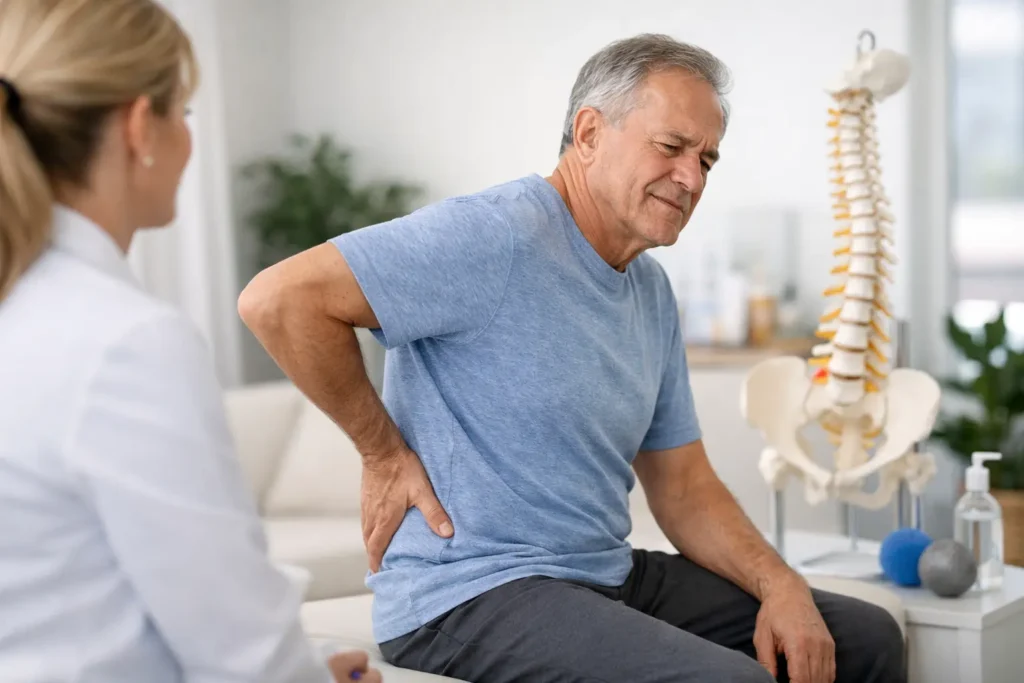
When walking through the grocery store starts to feel like a countdown to leg pain, numbness, or heaviness, many people begin to worry that surgery is their only option. The good news is that spinal stenosis without surgery is possible for many patients, especially when the problem is identified early and treated with a focused, biomechanical plan.
Spinal stenosis describes a narrowing within the spinal canal or the spaces where nerves travel. That narrowing can place pressure on the spinal cord or nerve roots, often leading to back pain, neck pain, tingling, weakness, balance changes, or pain that travels into the arms or legs. In many cases, the symptoms build gradually. Patients often notice they cannot stand or walk as long as they used to, yet they feel somewhat better when sitting down or bending forward.
This pattern matters because it helps guide treatment. Not every patient with stenosis needs an operation, and not every scan showing narrowing explains a person’s symptoms. Good care starts with matching the imaging, physical findings, nerve involvement, and functional limitations rather than treating an MRI report alone.
Can spinal stenosis without surgery really work?
For the right patient, yes. Non-surgical care can reduce irritation around the affected nerves, improve joint and soft-tissue mechanics, create better movement through compressed areas, and help patients return to more normal daily activity. The goal is not to pretend the anatomy is perfect. The goal is to decrease mechanical stress and improve function enough that pain no longer dominates everyday life.
That said, results depend on several factors. The degree of narrowing matters. So does the location of the stenosis, whether it involves the neck or low back, and whether there is significant weakness, bowel or bladder change, severe instability, fracture, infection, or another serious neurologic issue. Some patients respond very well to conservative treatment. Others may improve only partially and still need a surgical opinion.
This is why a detailed diagnostic evaluation is so important. In Neuromusculoskeletal Medicine, the focus is not just on where it hurts, but on why the load is falling there, which tissues are involved, and whether the nervous system is under pressure in a way that is progressive or urgent.
What causes spinal stenosis?
Most spinal stenosis is related to wear-and-tear changes that develop over time. Discs can lose height, joints can become arthritic, ligaments can thicken, and the available space for nerves can become tighter. Some patients also have disc bulging, bone spurs, postural collapse, old injuries, or instability that narrows the area further.
Age is part of the picture, but it is not the whole story. Active adults, people with physically demanding jobs, and patients with a history of repetitive strain or auto accident injury may notice symptoms earlier than expected. The same scan can look very different in two people functionally. One person has mild symptoms and stays active. Another struggles to stand, sleep, drive, or work comfortably.
That difference usually comes down to mechanics, inflammation, nerve sensitivity, and compensation patterns throughout the spine and surrounding soft tissues.
How non-surgical treatment is approached
The most effective care for spinal stenosis without surgery is usually not one single treatment. It is a structured plan based on examination findings, symptom behavior, and how your body responds over time.
Precise diagnosis comes first
A proper workup should look at posture, spinal motion, joint restriction, neurologic findings, gait, muscle guarding, and pain patterns. In some cases, imaging is necessary to confirm the level and severity of stenosis or to rule out other conditions. This matters because leg pain is not always coming from stenosis alone. Hip arthritis, sacroiliac dysfunction, peripheral nerve entrapment, vascular problems, and disc-related irritation can overlap.
When diagnosis is vague, treatment becomes trial and error. When diagnosis is specific, treatment becomes more efficient and safer.
Manual medicine can reduce mechanical stress
Hands-on treatment may help restore motion in restricted joints, reduce protective muscle tension, and improve how force is distributed through the spine. Patients often describe this as feeling less compressed, less stiff, and more able to move without triggering the same level of symptoms.
Not every manual technique is appropriate for every case. A patient with advanced degeneration, severe osteoporosis, marked instability, or acute neurologic decline needs a different approach than someone with moderate lumbar stenosis and mobility loss. Skilled treatment selection is part of the value of working with a board-certified physician trained in Neuromusculoskeletal Medicine rather than relying on a generic one-size-fits-all plan.
Non-Surgical Orthopedic Decompression may help selected patients
Decompression-based care is often considered when nerve pressure is related to disc collapse, joint loading, and reduced space in the lumbar or cervical spine. By gently creating more favorable mechanical conditions, decompression may reduce pressure on irritated tissues and improve symptom tolerance.
This is not a cure-all, and it is not indicated in every case. Some patients respond quickly. Others need a broader plan that includes decompression, manual treatment, and progressive exercise. The key is using it when the diagnosis supports it.
Targeted rehabilitation supports lasting change
If the spine is treated but the movement pattern that overloads it never changes, symptoms often return. Targeted rehabilitation helps strengthen supportive muscles, improve endurance, and retrain positions that reduce nerve irritation.
For many stenosis patients, the right exercises are less about aggressive stretching and more about controlled mobility, trunk support, hip function, walking tolerance, and positional strategies. Doing the wrong exercise plan can flare symptoms, especially if repeated extension movements aggravate the narrowing. This is another area where individualized care matters.
What patients can often improve without surgery
Many patients are not looking for perfection. They want to stand longer, sleep better, walk farther, drive with less leg pain, work more comfortably, and stop planning every day around symptom avoidance. Those are realistic goals with conservative care.
A successful non-surgical plan may reduce radiating pain, numbness, stiffness, and muscular guarding. It may also improve balance, tolerance for household activity, and confidence in movement. Even when imaging still shows degeneration, function can improve significantly.
This is an important distinction. Structural change on a scan does not always move at the same pace as clinical improvement. Patients sometimes worry that if the MRI still says stenosis, treatment is failing. In reality, many people do better because the tissues are less inflamed, the joints move better, and the nerves are less mechanically provoked.
When surgery should still be considered
There are times when avoiding surgery is not the safest path. Progressive weakness, major gait decline, loss of bowel or bladder control, severe cord compression, or symptoms that continue worsening despite appropriate conservative care deserve prompt specialist evaluation.
This is where honest medicine matters. A good non-surgical practice should not try to force every patient into the same treatment philosophy. It should identify who is a strong candidate for conservative care, who needs co-management, and who should be referred for surgical consultation. That balance protects patients and builds trust.
Who is a good candidate for spinal stenosis without surgery?
In general, patients do best when symptoms are bothersome but not rapidly progressive, when they still have functional reserve, and when the main drivers appear to be mechanical compression, degenerative change, soft-tissue restriction, and movement intolerance rather than severe neurologic compromise.
Patients who want to avoid medication escalation, remain active, and pursue a structured, diagnosis-driven plan are often strong candidates. Many have already tried rest, general exercise, or standard care without enough relief and are looking for a more specialized approach. In that setting, a careful combination of evaluation, manual medicine, decompression, and functional rehabilitation may offer a meaningful alternative.
For patients in Lafayette and the surrounding region, this is where a practice like Prather Neuromusculoskeletal Medicine can add value – not by promising that every case will avoid surgery, but by offering a higher-level diagnostic and non-surgical pathway before that step is taken.
What to expect from treatment
Most cases do not change overnight. Some patients feel relief early, especially when pressure-sensitive tissues calm down quickly. Others improve more gradually over several visits as the spine becomes less guarded and movement becomes easier.
The best plans are measured by function, not just pain scores. Can you walk farther? Sit through work more comfortably? Sleep with fewer interruptions? Get out of the car without that sharp leg pain? These daily markers tell you whether treatment is moving in the right direction.
Patience helps, but so does precision. If you have been told that surgery is the only answer, it is still reasonable to ask whether your condition has been fully evaluated from a non-surgical, neuromusculoskeletal standpoint. Sometimes the next right step is not a bigger procedure. It is a better diagnosis and a more targeted plan.