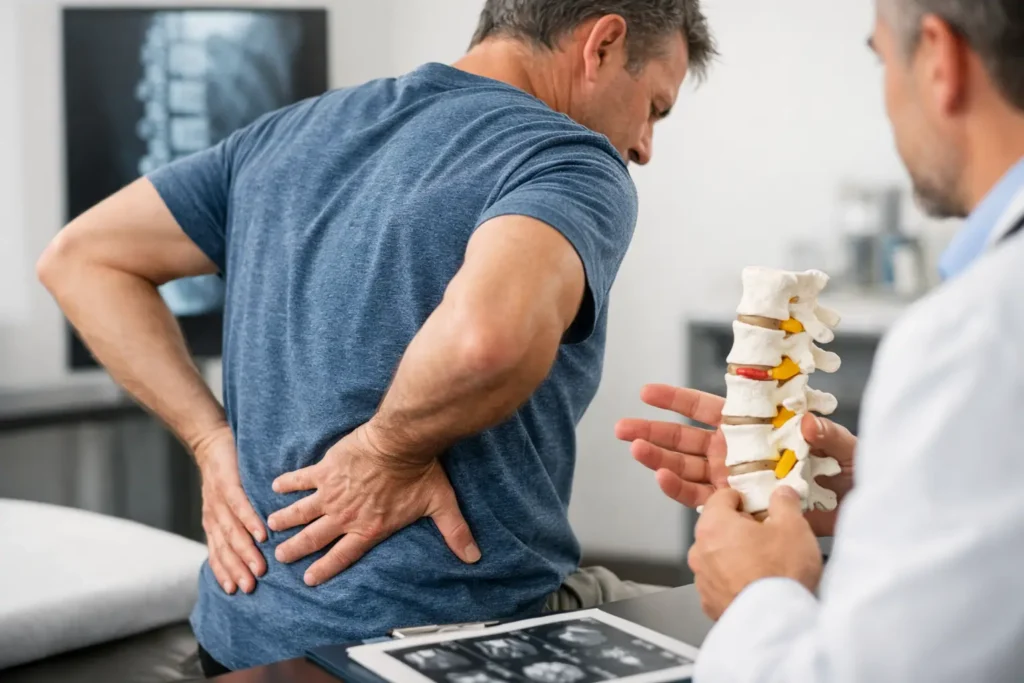
A disc bulge rarely starts as a dramatic event. For many patients, it begins as low back stiffness after sitting, neck pain that travels into the shoulder, or numbness that comes and goes in the arm or leg. When people ask how to treat disc bulge, they usually want one simple answer. In practice, the right treatment depends on which disc is involved, whether a nerve is irritated, and how much spinal compression is contributing to the problem.
A bulging disc is not always a surgical issue, and it is not always the true source of pain. That distinction matters. Effective care starts with a precise diagnosis, not a generic recommendation to rest, stretch, or take medication and wait.
What a disc bulge actually means
The spinal discs act as cushions between the vertebrae. Each disc has a tougher outer ring and a softer inner portion. A disc bulge occurs when the disc extends beyond its normal boundary, often because of degeneration, repetitive stress, poor mechanics, or trauma. In some patients, that bulge creates no symptoms at all. In others, it narrows space around nearby nerves and produces pain, tingling, numbness, weakness, or restricted movement.
This is one reason online advice can be misleading. Two people can both be told they have a disc bulge, yet one needs movement-based rehabilitation while the other needs decompression, manual treatment, or further medical workup. The label alone does not determine the plan.
How to treat disc bulge starts with diagnosis
If you want lasting improvement, the first question is not which exercise to do. It is whether the disc bulge is actually driving your symptoms.
A proper evaluation looks at pain patterns, neurologic findings, range of motion, injury history, posture, gait, muscle imbalance, and signs of spinal instability or compression. Imaging can be helpful, but it should support the clinical picture rather than replace it. Many adults have disc changes on MRI that are not the main reason they hurt.
That is where a specialist approach in Neuromusculoskeletal Medicine can make a real difference. The goal is to identify the pain generator and the mechanical stress that keeps aggravating it. If the disc is involved, treatment should be built around reducing irritation, improving motion in the right segments, and restoring function without increasing nerve compression.
The best treatment depends on severity
There is no universal answer for how to treat disc bulge because severity varies. A mild lumbar bulge with local soreness is different from a cervical disc bulge causing arm pain and weakness. A patient who developed symptoms after an auto accident may also have ligament injury, muscle spasm, or joint dysfunction layered on top of the disc problem.
In general, early treatment focuses on calming inflammation and reducing mechanical stress. That may include activity modification, but not complete inactivity. Too much bed rest often leads to more stiffness, deconditioning, and slower recovery. The better goal is controlled movement with the right support.
When symptoms involve radiating pain, numbness, or weakness, the treatment plan usually needs to be more structured. That is especially true if pain worsens with sitting, bending, lifting, or prolonged driving. Those patterns often point to disc-related loading that requires a more precise correction strategy.
Non-surgical treatment for a disc bulge
Most symptomatic disc bulges are treated without surgery. Non-surgical care is often most successful when it addresses both the irritated tissue and the biomechanical problem behind it.
Manual medicine and targeted spinal treatment
Hands-on treatment can help reduce abnormal joint restriction, muscle guarding, and compensatory strain around the affected area. The key word is targeted. Aggressive or poorly chosen manipulation is not appropriate for every patient with disc involvement. The treatment has to match the examination.
In a clinically guided setting, manual treatment may be used to improve motion above and below the affected level, reduce protective spasm, and decrease stress on compressed structures. This is not about forcing movement into a painful segment. It is about improving the mechanics of the whole region so the disc and nerve tissues are not constantly being aggravated.
Non-Surgical Orthopedic Decompression
For some patients, decompression is one of the most effective tools available. Non-Surgical Orthopedic Decompression is designed to reduce pressure within the spine and create a more favorable environment for disc recovery. This can be especially useful when a disc bulge is contributing to nerve irritation, sciatica, or persistent neck and back pain that has not responded to basic care.
Not every patient is a candidate, and not every bulging disc requires it. But when compression is a major factor, decompression may help reduce pain and improve tolerance for movement and rehabilitation. It is often most effective as part of a broader treatment plan rather than as a stand-alone service.
Therapeutic exercise and rehabilitation
Exercise is important, but timing and selection matter. The wrong movement can increase symptoms. The right one can centralize pain, improve stability, and reduce repeat injury.
Most disc rehabilitation focuses on core support, postural control, hip and thoracic mobility, and gradual loading. In cervical cases, shoulder girdle mechanics and upper back positioning often matter more than patients expect. In lumbar cases, simple changes in bending, sitting, and lifting strategy can reduce strain significantly.
A good rehab plan should feel purposeful, not random. If pain is worsening week after week, the program may need to be modified.
What to avoid when treating a disc bulge
One of the biggest mistakes is treating every bulging disc the same way. Internet routines often mix stretches, twisting movements, and strengthening drills without considering whether the disc is posterior, lateral, inflamed, or affecting a nerve root.
Another mistake is relying only on medication. Anti-inflammatory drugs or pain medication may reduce symptoms temporarily, but they do not correct joint dysfunction, compression patterns, or poor mechanics. Medication can have a role, but it should not be the whole plan.
Ignoring progressive neurologic symptoms is another serious issue. If you notice increasing weakness, loss of coordination, worsening numbness, or changes in bowel or bladder control, that requires prompt medical attention.
When imaging, injections, or surgery may be needed
Conservative care is often the first line, but there are times when additional intervention is appropriate. If symptoms are severe, not improving, or clearly associated with nerve deficit, imaging may be necessary to clarify the level and extent of involvement. In some cases, injection-based treatment may be considered to help control inflammation around an irritated nerve.
Surgery is usually reserved for more advanced cases, such as persistent neurologic loss, significant structural compression, or pain that remains disabling despite appropriate non-surgical treatment. The goal should never be to avoid surgery at all costs. The goal is to choose the least invasive treatment that safely gives you the best functional outcome.
That is why coordinated care matters. A provider should be willing to manage conservatively when appropriate and refer when the condition exceeds the limits of non-surgical treatment.
How to treat disc bulge and prevent it from coming back
Pain relief is only part of recovery. Long-term improvement usually depends on reducing the factors that overloaded the disc in the first place. That may include poor workstation setup, repetitive bending, weak trunk support, reduced hip mobility, chronic forward-head posture, or residual problems after an accident.
Prevention is not complicated, but it does require consistency. Patients tend to do best when they learn how their symptoms behave, which movements trigger compression, and how to modify daily activity without becoming fearful of movement. Good treatment should leave you more confident in your body, not more dependent on temporary fixes.
For many adults with disc-related pain, the best path is a careful diagnosis, a structured non-surgical plan, and close attention to how the spine is functioning as a system. At Prather Neuromusculoskeletal Medicine, that means looking beyond the scan and treating the mechanics, nerve irritation, and movement dysfunction that keep symptoms active.
If your pain has lingered, traveled, or started to interfere with work, sleep, or mobility, do not settle for a vague answer. The right treatment plan should make clinical sense, match your examination, and help you move toward relief with a clear purpose.