The question is not which treatment is stronger
When patients ask about ring dinger vs spinal decompression, they are often looking for relief from the same frustrating problems: persistent back or neck pain, a disc bulge, sciatica, headaches, stiffness after a car accident, or symptoms that have not improved with medication or routine care. Yet these treatments work very differently. One is a skilled manual procedure intended to restore motion and reduce mechanical restriction. The other is a measured, table-based approach intended to reduce pressure across spinal structures over a series of visits.
Neither treatment is automatically right for every painful spine. The better question is: what is creating the pain, and which treatment can address that problem safely? A careful Neuromusculoskeletal Medicine evaluation should guide that decision, particularly when symptoms involve numbness, weakness, radiating pain, prior surgery, trauma, or known disc disease.
What is the Ring Dinger treatment?
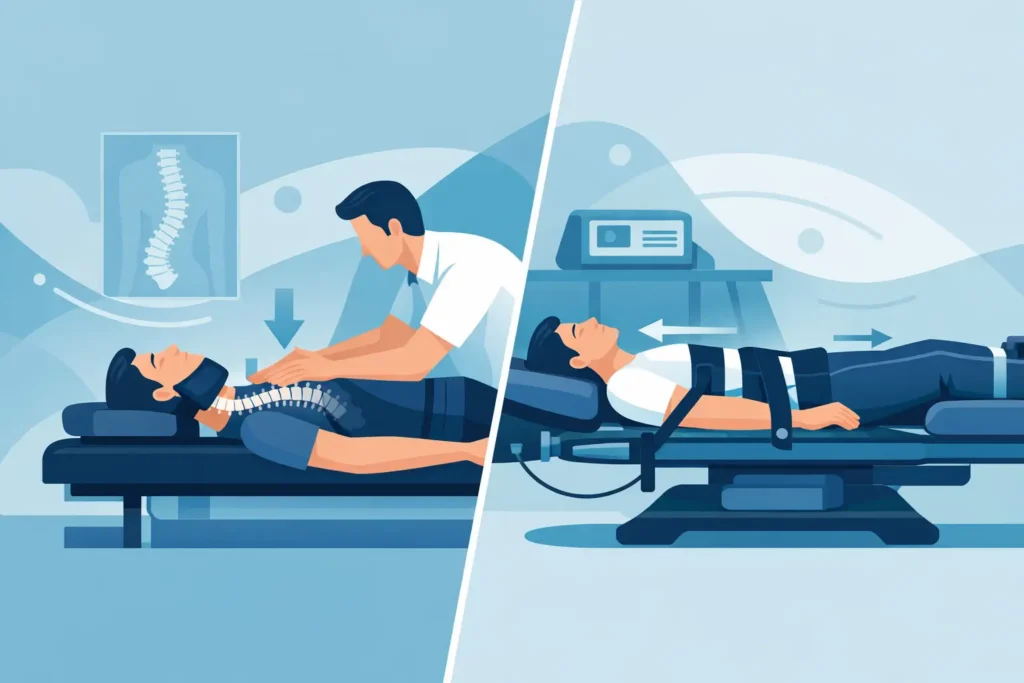
The Ring Dinger is a full-spine manual adjustment performed by a properly trained provider. It is commonly associated with a controlled long-axis traction movement that may create audible joint releases, often described as popping or cracking. Those sounds can be dramatic, but they are not the goal of treatment. They are simply a possible result of changes in joint pressure and motion.
The clinical purpose is to address spinal joint restriction, altered mechanics, muscular guarding, and certain patterns of reduced mobility. For a patient whose spine has become stiff and protective after prolonged sitting, repetitive work, a minor injury, or chronic postural strain, appropriate manual treatment may help restore movement and reduce discomfort.
A Ring Dinger procedure is not a generic tug or a forceful maneuver performed without assessment. Proper application requires attention to the patient’s history, examination findings, spinal stability, bone health, neurologic signs, and tolerance for manual care. Dr. Eric J. Prather‘s role as a Certified Team Ring Dinger® physician is relevant because the technique should be considered within a broader diagnostic and clinical framework, not treated as a social-media spectacle.
When manual treatment may be considered
Manual treatment may be appropriate when examination points to restricted spinal motion, joint dysfunction, muscle guarding, or mechanical pain without signs that traction or manipulation would place the patient at unnecessary risk. Some patients experience a rapid sense of improved mobility after treatment. Others need a series of visits that includes soft-tissue work, targeted rehabilitation, posture changes, or additional diagnostic review.
The response varies. Relief after an adjustment does not prove that every underlying condition has been corrected, and short-term improvement should never replace a thorough plan for recurrent or progressive symptoms.
What is non-surgical spinal decompression?
Non-surgical orthopedic decompression uses a specialized traction system to apply carefully controlled distraction forces to the spine. The patient is positioned on a treatment table while the system cycles through prescribed levels of pull and relaxation. The objective is to reduce loading across targeted spinal segments and create a more favorable environment for irritated discs, nerve roots, and surrounding tissues.
Spinal decompression is often discussed for lumbar or cervical disc conditions, including disc protrusions, bulges, herniations, degenerative disc changes, and nerve irritation that may contribute to sciatica or radiating arm pain. It is typically delivered as a treatment program rather than a one-time intervention. The pace, angle, force, and number of sessions should be individualized according to the diagnosis and the patient’s response.
This approach is generally gradual. It does not depend on a high-velocity thrust or an audible release. Patients may be drawn to decompression when their symptoms are aggravated by compression, prolonged standing, sitting, bending, or certain daily movements. For some, the controlled nature of table-based treatment feels more comfortable than hands-on manipulation.
What decompression can and cannot do
Decompression may reduce mechanical stress and help some patients manage disc-related symptoms without surgery. It can be a valuable component of a conservative care plan, especially when paired with an examination-driven strategy for movement, tissue health, and daily activity.
It is not a guaranteed way to eliminate every disc problem, reverse all degeneration, or avoid surgery in every case. Progressive weakness, bowel or bladder changes, severe trauma, fracture concerns, infection, cancer-related spinal disease, or other red-flag findings require timely medical evaluation rather than routine decompression. Some patients with surgical indications need coordinated care with a surgeon or other medical specialist.
Ring Dinger vs spinal decompression: the practical differences
The most meaningful difference is how each treatment applies force. The Ring Dinger is a direct, hands-on manual procedure performed during an office visit. It is intended to influence joint motion and mechanical restriction immediately. Spinal decompression applies controlled traction over time, with the aim of reducing pressure and irritation in selected spinal regions.
The second difference is treatment rhythm. A manual adjustment may be part of a single visit or an ongoing plan, depending on the patient’s findings and progress. Decompression is usually prescribed as a structured series because the therapeutic effect is designed to build through repeated, measured sessions.
The third difference is patient selection. A patient with acute muscle guarding and restricted joint motion may benefit from carefully chosen manual therapy. A patient with persistent leg pain linked to a disc-related pattern may be a stronger candidate for decompression, assuming the examination supports it. Many patients do not fit neatly into one category. A combined plan may use manual medicine to improve mobility while decompression addresses disc and nerve-related loading.
Why diagnosis matters more than the treatment name
A painful spine can produce similar symptoms for very different reasons. Low back pain may arise from disc irritation, facet joint dysfunction, muscle strain, hip mechanics, nerve compression, arthritis, or a combination of factors. Neck pain after a collision may involve whiplash-related soft-tissue injury, joint restriction, headache patterns, and neurologic irritation. Treating all of these conditions with the same technique is not personalized care.
That is why a clinical evaluation should include a detailed history, orthopedic and neurologic examination, review of imaging when appropriate, and an assessment of how symptoms affect work, sleep, walking, exercise, and daily function. In-house imaging support and referral coordination can help clarify whether conservative treatment is reasonable or whether another level of care is needed.
For auto accident injuries, this distinction is particularly important. Pain may not fully appear until hours or days after a collision, and a patient can have significant soft-tissue or disc-related symptoms even when initial discomfort seems manageable. Early assessment creates a clearer baseline and helps direct care before compensatory movement patterns become more established.
What a well-designed plan should feel like
A thoughtful treatment plan should give you more than a temporary sensation of being adjusted or stretched. You should understand the working diagnosis, the goals of care, what changes to watch for, and why a specific treatment has been recommended. Progress may include less radiating pain, improved range of motion, better sleep, increased walking tolerance, or a return to work and activity with fewer limitations.
It should also include honest reassessment. If a treatment is not producing meaningful functional change, the plan may need to be modified. Patients deserve attentive listening, clear explanations, and a provider willing to coordinate with other specialists when the findings call for it.
If you are deciding between manual treatment and decompression for neck pain, back pain, sciatica, disc symptoms, or an auto accident injury, schedule a Complimentary NeuroSpinal Case Review with Prather Neuromusculoskeletal Medicine. Call 337-984-3113 or book online at www.prathernmm.com or www.prathernmsk.com to schedule. The most useful next step is a precise diagnosis that gives your spine a sensible path forward.