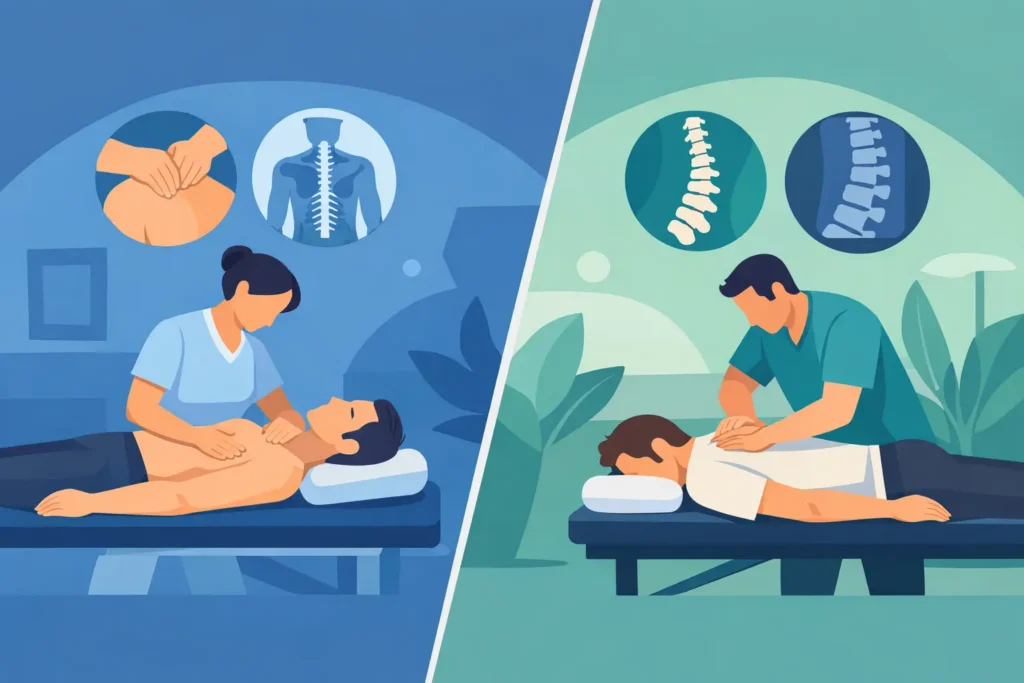
A painful neck after a car accident, sciatica that interrupts sleep, or low back pain that returns every time you bend can make choosing care feel urgent. The question of manual medicine vs chiropractic care is not simply about which treatment feels best. It is about finding the right level of diagnostic evaluation, clinical training, and treatment strategy for the structures causing your symptoms.
Both approaches use hands-on treatment and can help patients improve motion, reduce pain, and return to daily activity. Yet their scope, clinical framework, and role in a complex case may differ substantially. For patients with persistent pain, disc concerns, nerve irritation, injury-related symptoms, or a history of treatment that did not provide lasting relief, those differences matter.
What Is Manual Medicine?
Manual medicine is a broad clinical discipline focused on diagnosing and treating dysfunction in the musculoskeletal and nervous systems through skilled hands-on assessment and treatment. It considers how the spine, joints, muscles, connective tissue, nerves, posture, movement patterns, and prior injuries work together.
A manual medicine evaluation should begin well before a treatment table. The clinician reviews the onset of symptoms, mechanism of injury, pain pattern, functional limitations, neurological signs, prior imaging, health history, and response to previous care. They may assess joint motion, muscle strength, reflexes, sensation, gait, tissue tenderness, and the way different regions of the body compensate for one another.
Manual treatment may include joint mobilization or manipulation, soft-tissue techniques, myofascial work, muscle energy methods, positional treatment, guided movement, and other approaches selected for the patient’s presentation. It can also be combined with a broader plan that includes imaging support, activity modification, rehabilitation guidance, specialist coordination, or Non-Surgical Orthopedic Decompression when clinically appropriate.
The central idea is not to apply one technique to every complaint. It is to identify the biomechanical and neuromusculoskeletal factors contributing to a patient’s pain and select care accordingly.
What Is Chiropractic Care?
Chiropractic care commonly focuses on the relationship between spinal mechanics, joint function, and the nervous system. Chiropractors are trained to evaluate musculoskeletal complaints and use spinal or extremity adjustments, mobilization, soft-tissue methods, exercise recommendations, and other conservative therapies.
For many people, chiropractic care is sought for uncomplicated back pain, neck stiffness, headaches associated with cervical dysfunction, reduced mobility, or joint discomfort. A carefully delivered adjustment may improve joint motion and decrease the protective muscle tension that often develops around a painful area.
Chiropractic care is not one uniform experience. Techniques, diagnostic processes, treatment frequency, and clinical philosophy vary from one provider to another. Some practices emphasize routine adjustments, while others use a more extensive orthopedic and neurological evaluation to guide treatment decisions.
That variation is why patients should look beyond the name of a profession. Ask what examination will be performed, how the provider determines whether manipulation is appropriate, whether imaging or referral may be needed, and how progress will be measured.
Manual Medicine vs Chiropractic Care: Where They Overlap
Manual medicine and chiropractic care overlap in meaningful ways. Both may use hands-on techniques to address restricted joint motion, muscular guarding, soft-tissue tension, and movement-related pain. Both can be part of a non-surgical plan for patients who want to reduce reliance on medication and improve function.
Both also require sound clinical judgment. Manipulation is not automatically appropriate because a patient has pain. The source of pain may be a strained muscle, an irritated nerve root, a disc protrusion, joint degeneration, a fracture risk, inflammatory disease, or a condition outside the musculoskeletal system. The treatment plan should reflect that distinction.
For a straightforward mechanical complaint, there may be considerable overlap in what the patient experiences: a focused exam, hands-on care, advice about movement, and reassessment over time. The difference becomes clearer when symptoms are complex, severe, recurrent, or associated with trauma or neurological changes.
The Difference Often Comes Down to Diagnostic Depth
The most practical distinction in manual medicine vs chiropractic care is often the framework used to investigate the problem before treatment begins. Manual medicine, particularly within a Neuromusculoskeletal Medicine setting, places strong emphasis on identifying how the spine, nerves, joints, muscles, and soft tissues contribute to the symptom pattern.
Consider an auto accident patient with neck pain, headaches, shoulder pain, and numbness into the hand. A generic approach might focus only on where the pain is felt. A more detailed neuromusculoskeletal evaluation asks additional questions: Is the cervical spine irritating a nerve? Is shoulder dysfunction contributing? Is there ligament injury, disc involvement, muscle guarding, or altered movement from whiplash? Are there findings that warrant imaging, modified treatment, or medical co-management?
The same is true for low back pain with leg symptoms. Sciatica may arise from nerve irritation related to a disc injury, narrowing around a nerve, pelvic or hip dysfunction, deep muscle involvement, or several factors at once. A patient may benefit from manipulation, but may also need decompression, specific manual methods, exercise progression, or referral when their findings indicate a different path.
This does not mean more testing is always better. It means the examination should be thorough enough to match the severity and complexity of the complaint.
Technique Is Only One Part of Effective Care
Patients sometimes compare care based on a single technique, especially a forceful spinal adjustment or a highly visible decompression procedure. Technique can matter, but it is only one part of a quality treatment plan.
A technique that is appropriate for a patient with restricted thoracic motion may not be appropriate for someone with acute inflammation, significant osteoporosis risk, fracture concerns, severe neurological deficits, or an injury that has not been adequately evaluated. Likewise, a patient who has tried routine adjustments without durable improvement may not need more of the same approach. They may need a clearer diagnosis and a revised treatment strategy.
At Prather Neuromusculoskeletal Medicine, the goal is to match care to the condition rather than force the condition into a predetermined protocol. Dr. Eric J. Prather’s board-certified Neuromusculoskeletal Medicine approach combines detailed clinical evaluation with manual treatment and non-surgical options for patients whose symptoms require more than a brief, generalized visit.
When Manual Medicine May Be a Better Fit
Manual medicine may be particularly valuable when pain has persisted despite prior care, when several body regions are involved, or when symptoms suggest nerve, disc, or injury-related involvement. It may also be a strong option for patients who need a conservative plan but want more diagnostic clarity before moving toward injections, long-term medication, or surgery.
Seek prompt clinical evaluation if you have pain after an auto accident, pain that travels into an arm or leg, numbness, tingling, weakness, worsening headaches after trauma, major loss of mobility, or symptoms that are progressing rather than improving. Those signs do not automatically indicate a serious condition, but they deserve an examination that goes beyond a quick assumption.
For some patients, chiropractic adjustment can be an appropriate component of care. For others, the better choice is a manual medicine plan that integrates orthopedic assessment, neurological screening, imaging support when indicated, soft-tissue and joint treatment, and decompression-based care. In more serious cases, the right outcome is not another manual procedure at all. It is timely referral or coordinated care with the appropriate medical or surgical specialist.
Choosing Care With Confidence
The best question is not, “Which profession is better?” It is, “What does my condition require?” A qualified provider should explain what they believe is causing your symptoms, what treatment is recommended, what alternatives exist, and what changes would require a different plan.
Look for a practice that listens closely, examines you thoroughly, and does not promise that one method is right for every spine or every injury. Meaningful relief is more likely when care is guided by your actual diagnosis, functional goals, and response to treatment.
If pain, injury, or unresolved symptoms are limiting your life, schedule a Complimentary NeuroSpinal Case Review with Prather Neuromusculoskeletal Medicine. Call 337-984-3113 or book online at www.prathernmm.com or www.prathernmsk.com to discuss a personalized, non-surgical path toward better movement and relief.