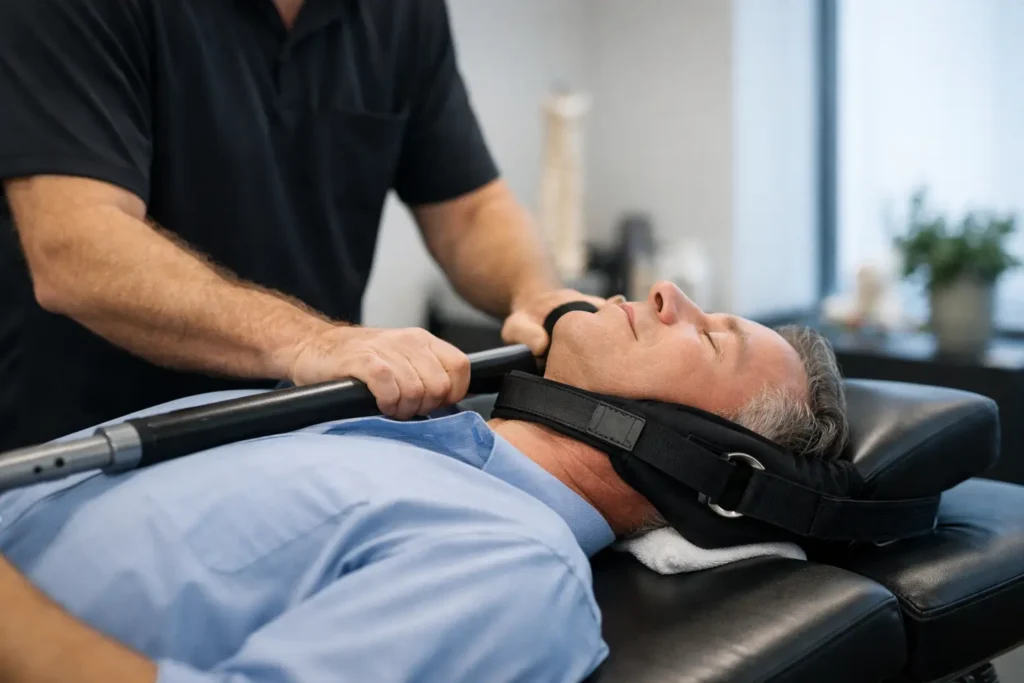
Neck pain rarely starts as “just a stiff neck.” For many patients, it is a mix of joint restriction, muscle guarding, disc pressure, nerve irritation, poor mechanics, and sometimes old injury that never fully resolved. That is why interest in a ring dinger for neck pain has grown – people are looking for meaningful decompression and relief when stretching, medication, or routine care has not done enough.
The key question is not whether a Ring Dinger® looks dramatic. The real question is whether it is clinically appropriate for your specific condition.
What a ring dinger for neck pain is meant to do
The Ring Dinger® is a specialized spinal decompression-style manual technique designed to create a traction-based adjustment through the spine. In the right patient, the goal is to reduce compression, improve segmental motion, and relieve pressure patterns that can contribute to neck pain, headaches, radiating symptoms, and restricted mobility.
When patients describe their neck pain, they often mention more than soreness. They talk about pressure at the base of the skull, pain turning while driving, numbness into the shoulder or arm, tension headaches, or a heavy, compressed feeling after long workdays. In those cases, the cervical spine is only part of the picture. The upper thoracic region, posture, discs, fascia, and surrounding musculature may all be contributing.
A ring dinger for neck pain is not simply about “cracking” the neck. In a clinical setting, it is used as part of a broader treatment strategy focused on decompression, biomechanics, and neuromusculoskeletal function.
When neck pain may respond well
Some patients do very well with traction-based manual care. Others need a different approach. That distinction matters.
Neck pain may respond favorably when there is mechanical restriction, compressive loading, postural collapse through the cervical and thoracic spine, or pain patterns associated with reduced motion and pressure sensitivity. Patients with chronic stiffness, recurrent cervicogenic headaches, certain disc-related complaints, and neck pain after prolonged sitting sometimes report relief when decompression improves how the spine moves and bears load.
This can also be relevant after an auto accident, where soft-tissue injury, joint dysfunction, and muscle guarding may leave the neck feeling compressed long after the initial event. But even then, timing and case selection are important. A fresh injury is not managed the same way as a chronic unresolved condition.
The phrase “it depends” is not a hedge here. It is good medicine. Neck pain has many causes, and the same symptom can come from very different structures.
When it may not be the right choice
Not every patient with neck pain should receive a Ring Dinger®-style adjustment. That is one of the most important points to understand.
If pain is being driven by fracture, instability, severe osteoporosis, certain vascular concerns, advanced neurologic compromise, inflammatory disease, postsurgical complications, or a condition that requires urgent medical management, then high-level manual decompression may be inappropriate or postponed. Some patients also need imaging, orthopedic testing, or specialist coordination before any force-based treatment is considered.
Even in less severe cases, a ring dinger for neck pain may not be the best first step if the primary issue is acute muscle spasm, significant guarding, severe inflammation, or pain that is too irritable to tolerate traction. In those situations, the safer and more effective path may begin with gentler manual medicine, soft-tissue treatment, targeted decompression, or a staged treatment plan.
That is why diagnosis comes before technique.
Why evaluation matters more than the adjustment itself
Patients often search for a specific treatment because they want relief fast. That makes sense. But a technique should follow the diagnosis, not replace it.
A proper neuromusculoskeletal evaluation looks at symptom history, mechanism of injury, range of motion, neurologic findings, orthopedic testing, pain referral patterns, and the structural behavior of the cervical and thoracic spine. When needed, imaging helps clarify whether the pain reflects degenerative change, disc involvement, alignment issues, or something more complex.
This is where a board-certified Neuromusculoskeletal Medicine approach stands apart from one-size-fits-all care. The focus is not on giving every patient the same adjustment. The focus is on identifying the pain generator and selecting the safest, most effective intervention for that individual.
Sometimes that includes a Ring Dinger®. Sometimes it includes non-surgical orthopedic decompression, manual manipulation, myofascial treatment, exercise guidance, or co-management with another specialist. Good outcomes usually come from matching treatment to pathology, not from forcing pathology to fit a treatment.
What patients commonly feel after treatment
When the technique is appropriate and performed correctly, patients often describe a sense of release, improved neck rotation, reduced pressure, or easier posture immediately after treatment. Others notice that headaches lessen, shoulder tension decreases, or they can move without the same pinching sensation.
That said, immediate relief is not the only measure that matters. Some patients feel sore for a short period afterward, especially if the spine has been restricted for a long time or if surrounding muscles have adapted to compression. Short-term soreness does not necessarily mean the treatment was wrong, but it should be anticipated, monitored, and kept within reasonable limits.
Response also depends on the chronicity of the condition. A patient with years of disc degeneration, poor workstation mechanics, and repeated flare-ups may improve, but usually not from a single visit alone. Decompression can create a window of relief. Keeping that relief often requires follow-up care and correcting the underlying mechanics that keep reloading the neck.
The risks patients should understand
Any hands-on neck treatment should be discussed honestly. That includes benefits, limitations, and risk.
A ring dinger for neck pain is a specialized manual procedure, and the cervical spine is a region where precision matters. The major safeguard is not marketing. It is patient selection, exam quality, medical judgment, and provider training. If a practitioner is not carefully evaluating the case, identifying contraindications, and explaining why the treatment fits, that should raise concern.
Patients should also know that dramatic-looking treatment is not automatically better treatment. More force is not inherently more effective. In some cases, gentle decompression and progressive care produce better and more durable results than one aggressive intervention.
The right standard is simple: the treatment should make clinical sense for the anatomy, symptoms, and safety profile in front of you.
Ring dinger for neck pain and a full treatment plan
The best results usually come when the adjustment is part of a broader care model. Neck pain often improves more predictably when decompression is paired with soft-tissue work, postural correction, mobility restoration, and strategies that reduce recurrent compression through the workday.
For example, a patient with forward head posture, upper thoracic stiffness, and recurrent headaches may need more than one decompression-focused visit. They may also need guidance on workstation setup, sleep positioning, and exercises that help maintain cervical support. A patient with arm symptoms may need a more disc-focused and neurologic approach. A patient recovering from a motor vehicle collision may need treatment that accounts for inflammation, ligament stress, and compensation patterns elsewhere in the spine.
At Prather Neuromusculoskeletal Medicine, that kind of structured decision-making is central to care. The goal is not simply to perform a technique. The goal is to reduce pain, improve function, and make sure the treatment path is medically appropriate.
How to decide whether to pursue it
If you are considering a ring dinger for neck pain, start by asking better questions than “Does it work?” Ask what is causing your neck pain. Ask whether compression is part of the problem. Ask whether you have any red flags, instability, or disc and nerve findings that change the plan. Ask what the provider would do if you are not a candidate.
That last question matters. A serious clinic should be willing to tell you when a Ring Dinger® is not the right fit and offer a safer alternative or referral when needed.
Neck pain can wear down your concentration, sleep, work performance, and confidence in your own movement. The right treatment can feel life-changing, but only when it is chosen for the right reasons. If your neck has been telling you something for months or years, the next step should be clarity, not guesswork.
A careful diagnosis often brings relief before the treatment even begins, because once you understand what is driving the pain, the path forward becomes much easier to trust.