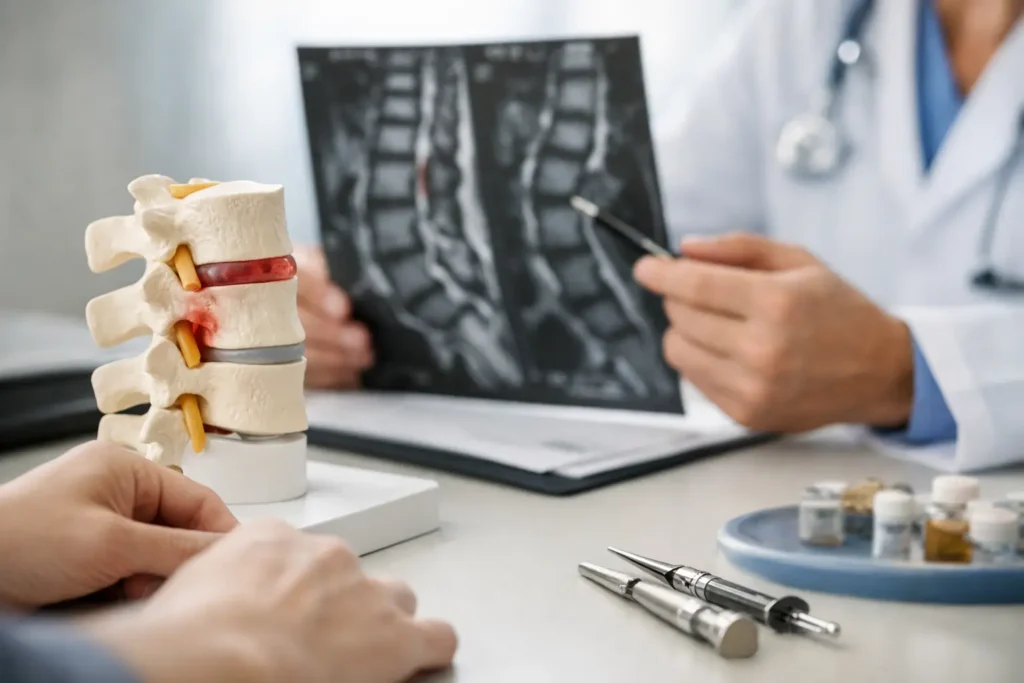
A sharp catch in the low back when you bend, sit, or stand up from a chair can be more than a simple strain. In many cases, annular fissure treatment options become part of the conversation when the outer layer of a spinal disc develops a tear and starts triggering pain, inflammation, or nerve irritation.
An annular fissure is a disruption in the annulus fibrosus, the tough outer ring of an intervertebral disc. Some fissures cause no symptoms at all. Others create persistent back pain, referred pain into the hip or leg, muscle guarding, and difficulty tolerating sitting, lifting, twisting, or prolonged driving. That range matters because treatment should match the severity of the problem, the patient’s exam findings, and whether the disc injury is stable or progressing.
What an annular fissure actually means
A spinal disc has two main parts – the softer inner nucleus pulposus and the stronger outer annulus fibrosus. An annular fissure occurs when fibers in that outer ring split or tear. This may happen after repetitive stress, degeneration over time, a lifting injury, or a car accident. In some patients, it is found incidentally on imaging. In others, it becomes the pain generator.
The difficulty is that back pain is not always caused by one structure alone. A fissured disc can exist alongside segmental dysfunction, spinal compression, muscle spasm, reduced mobility, and nerve sensitivity. That is why a precise neuromusculoskeletal evaluation matters. The goal is not simply to name the MRI finding. The goal is to determine whether that finding matches the patient’s symptoms and functional limitations.
Annular fissure treatment options depend on the full picture
There is no single best treatment for every annular fissure. Some patients improve with time and conservative care. Others need a more structured plan because pain persists, motion becomes restricted, or the injured disc starts irritating nearby nerves.
The most appropriate annular fissure treatment options usually depend on several factors: whether symptoms are acute or chronic, whether pain stays in the back or travels into the leg, whether there is associated disc bulging or herniation, and how much the condition is affecting work, sleep, exercise, and daily movement.
Relative rest and activity modification
In the early stage, reducing aggravating activities is often necessary. That does not mean complete bed rest. In fact, too much inactivity can worsen stiffness and deconditioning. It usually means temporarily avoiding repetitive bending, heavy lifting, prolonged sitting, and loaded twisting while the irritated disc settles down.
For many patients, small mechanical changes help more than they expect. Shorter sitting intervals, better lumbar support, careful movement transitions, and limiting high-compression activities can reduce repeated stress across the injured disc. This phase is not glamorous, but it often creates the foundation for everything that follows.
Targeted manual medicine and biomechanical correction
When an annular fissure is part of a broader mechanical problem, hands-on treatment can be valuable. The key is proper case selection. If the spine is guarded, compressed, and moving poorly, carefully directed manual treatment may help reduce abnormal loading patterns, improve segmental motion, and decrease secondary muscle spasm.
This is also where clinical judgment matters. Not every patient with disc pain should receive the same type of manipulation, and force selection matters. A specialist in Neuromusculoskeletal Medicine evaluates the disc injury in context, then decides whether treatment should focus on mobility restoration, decompression principles, soft tissue work, or more protective strategies first.
Non-Surgical Orthopedic Decompression
For patients whose symptoms are driven by disc compression, loss of disc space mechanics, or nerve irritation, Non-Surgical Orthopedic Decompression may be considered. The purpose is to reduce mechanical pressure on affected spinal structures and improve the environment around the injured disc.
This can be especially relevant when an annular fissure is accompanied by disc bulging, radiating pain, or symptoms that worsen with spinal loading. Decompression is not a universal solution, and it is not appropriate for every spine condition. But in the right patient, it can be an important part of a conservative treatment plan designed to lower irritation without surgery.
Therapeutic exercise and stabilization
Once acute irritation begins to calm down, exercise becomes important. The right program helps restore spinal support, improve hip and core coordination, and reduce the chance that the same disc segment keeps getting overloaded.
This should be more specific than general stretching found online. Some patients need extension-biased movements, while others do better with neutral-spine stabilization or controlled flexion avoidance early on. If a patient has nerve irritation, timing and dosage matter. Too much too soon can flare symptoms. Too little can prolong recovery.
Anti-inflammatory support and pain management
Some patients use anti-inflammatory medication or other physician-guided pain management measures to reduce acute discomfort. This can help make movement and rehabilitation more tolerable. Still, medication has limits. It may dull symptoms without correcting the mechanics that continue to provoke the disc.
That trade-off is worth understanding. Pain relief is useful, but lasting improvement usually requires a plan that addresses loading patterns, spinal function, and tissue recovery.
When imaging and advanced evaluation matter
An annular fissure may be suspected based on symptoms and examination, but imaging can be important when pain is severe, symptoms persist, trauma is involved, or nerve findings appear. MRI is often the study that identifies the disc injury and shows whether there is associated bulging, herniation, stenosis, or nerve root involvement.
Imaging should support clinical decision-making, not replace it. Many people have disc findings on MRI that are not the true cause of their pain. On the other hand, if a patient has progressive weakness, major neurological changes, or signs that suggest a more serious disc problem, delayed evaluation is not the right approach.
A board-certified specialist who works in spine and soft-tissue injury can help distinguish between a disc that is merely visible on imaging and a disc that is actively driving symptoms.
Injections and other escalated options
If conservative care is not enough, some patients are referred for interventional treatment. Depending on the case, that may include epidural steroid injection or other image-guided procedures intended to calm inflammation around irritated nerve tissue.
These options can be helpful, particularly when leg pain, inflammation, or acute radicular symptoms are limiting progress. But they are usually best viewed as part of a broader treatment strategy, not a stand-alone fix. If the underlying biomechanical stress remains unchanged, symptoms can return.
There are also cases where surgical consultation becomes appropriate. That is more likely when there is significant neurological deficit, failure of well-managed conservative care, or a structural disc issue that is unlikely to respond fully to non-surgical measures alone. A responsible spine practice does not force every patient into one lane. It coordinates care when higher-level intervention is necessary.
What to avoid when treating a fissured disc
One of the most common mistakes is chasing pain with random treatments while ignoring the diagnosis. Another is assuming every annular fissure needs aggressive intervention. Both approaches can delay recovery.
High-force or poorly selected treatment can aggravate an already sensitized disc. Generic exercise routines can also backfire if they repeatedly load the injured segment. Even daily habits matter. Long commutes, slumped sitting, repeated lifting from the floor, and returning too quickly to the gym can keep the tissue irritated.
That is why personalized care matters. A patient with a small fissure and mild localized pain may need a different plan than someone with post-accident disc injury, leg symptoms, and significant functional loss.
What recovery usually looks like
Recovery is rarely a straight line. Many patients improve in stages. Pain decreases first, then movement gets easier, then sitting and work tolerance improve, and only later does confidence in normal activity return. Flares can happen during healing, especially if the disc is stressed too early.
In a clinical setting such as Prather Neuromusculoskeletal Medicine, the focus is not simply on short-term pain control. It is on identifying the mechanical and neuromusculoskeletal factors keeping the injury active, then building a treatment plan around restoring function while reducing the likelihood of recurrence.
That may include a combination of manual medicine, decompression-based care, movement correction, and coordinated referral if the presentation suggests a need for imaging or specialist intervention. For patients trying to avoid unnecessary drugs or surgery, that measured approach often makes far more sense than guessing.
If your back pain has been lingering, worsening with sitting, or radiating in a way that does not feel like a routine muscle strain, it is worth getting the disc properly evaluated. The right treatment is not always the most aggressive option. It is the one that matches the actual cause of the pain and gives your spine the best chance to heal.