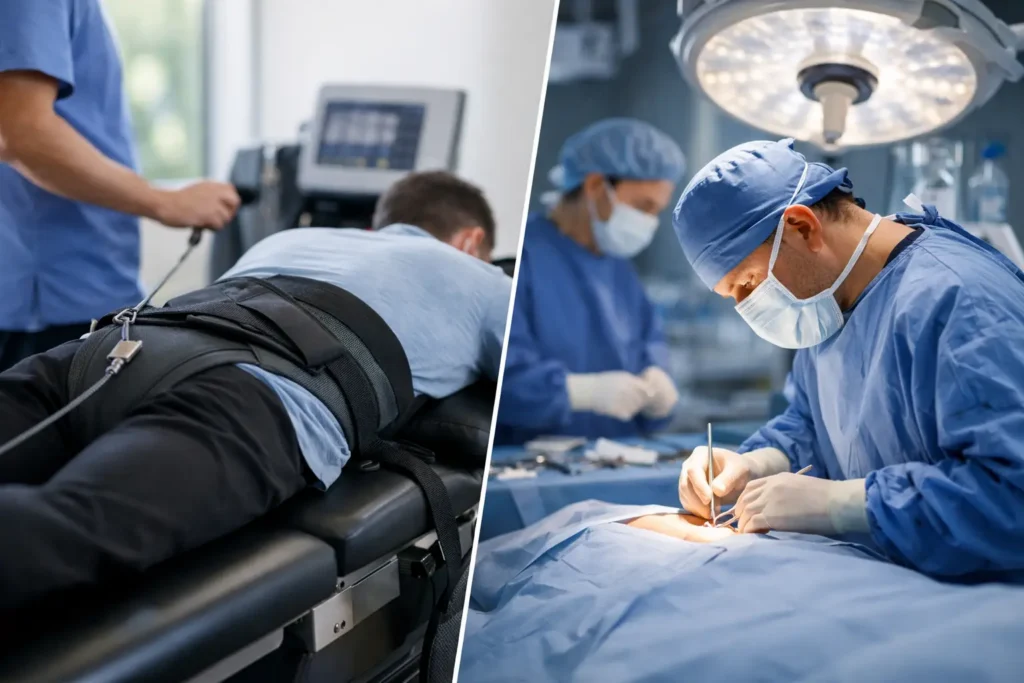
When pain shoots down your leg, your arm goes numb, or your back starts limiting how you work, sleep, and move, the question becomes very practical very quickly: orthopedic decompression vs surgery – which one actually makes sense for your condition? For many patients, the answer is not as simple as “avoid surgery” or “go straight to an operation.” It depends on the source of compression, the severity of tissue damage, the presence of neurologic loss, and whether the problem is likely to respond to a non-surgical mechanical approach.
At a clinical level, both options aim to reduce pressure on irritated structures. The difference is how that goal is reached. Non-Surgical Orthopedic Decompression attempts to improve spacing, reduce mechanical stress, and calm irritated discs, joints, and nerves without cutting into tissue. Surgery changes anatomy more directly and may be necessary when there is structural compromise, instability, progressive neurologic deficit, or failure of conservative care.
Orthopedic decompression vs surgery: what is the real difference?
Orthopedic decompression is a non-invasive treatment approach used to reduce compression across the spine or involved joint structures. In many cases, it is applied when disc irritation, nerve impingement, degenerative change, or mechanical restriction is contributing to pain, numbness, weakness, or limited mobility. The goal is to create a more favorable biomechanical environment so inflamed tissues can settle and function can improve.
Surgery, by contrast, is an invasive intervention designed to correct or remove the source of compression directly. Depending on the diagnosis, that may involve removing disc material, enlarging the space around a nerve, stabilizing a segment, or replacing damaged tissue. In the right case, surgery can be highly effective. In the wrong case, or when pursued too early, it may expose the patient to risk, recovery time, and cost before appropriate conservative options have been fully explored.
This is where careful diagnosis matters. A patient with disc-related leg pain but no progressive weakness may be a reasonable candidate for decompression-based care. A patient with severe cord compression, bowel or bladder changes, fracture, infection, or rapidly worsening neurologic symptoms may require surgical evaluation without delay. The distinction is not philosophical. It is clinical.
When non-surgical orthopedic decompression may be the better first step
For many adults with back pain, neck pain, radiating extremity symptoms, or post-injury mechanical dysfunction, a non-surgical route deserves serious consideration first. That is especially true when imaging and physical examination suggest compression or irritation without an emergency surgical indication.
Orthopedic decompression may be appropriate when the problem involves disc bulging, disc degeneration, foraminal narrowing, nerve root irritation, facet stress, or chronic spinal loading patterns that worsen with work, driving, lifting, or prolonged sitting. It may also fit patients who want to avoid medication dependence or who have been told they have “wear and tear” but have never received a thorough neuromusculoskeletal evaluation.
The advantage of a decompression-based approach is that it can address mechanics while preserving normal tissue. There is no incision, no anesthesia, and no surgical downtime. That does not mean it is effortless or automatic. Patients still need an accurate diagnosis, a tailored treatment plan, and realistic expectations. But when the source of pain is mechanical and responsive, non-surgical care can reduce symptoms and improve movement without the risks associated with an operation.
This is also where specialist training makes a difference. A board-certified physician in Neuromusculoskeletal Medicine is not simply asking whether you hurt. The more important question is why you hurt. Is the pain discogenic, articular, muscular, neurologic, ligamentous, or a combination? Is the compression primary, or is it secondary to instability, posture, degeneration, or trauma? Those distinctions affect whether decompression is likely to help.
When surgery is the right choice
There are situations where surgery should not be delayed. Progressive motor weakness, significant spinal instability, severe stenosis with neurologic compromise, fractures, tumors, infections, and certain advanced structural failures move the conversation into a different category. In those cases, conservative care is not a substitute for surgical management.
Surgery may also be appropriate when a patient has completed a reasonable course of well-directed conservative treatment and still has disabling pain or loss of function. The key phrase is well-directed. Many people are told they “failed conservative care” when what they actually failed was a generic approach that never matched the diagnosis.
Even then, surgery is not a simple yes-or-no issue. The type of procedure matters. So does the expected outcome. Some operations are excellent for relieving nerve compression but less reliable for eliminating every form of chronic pain. Others may stabilize a segment but create long-term stress at adjacent levels. A responsible recommendation should include both the likely benefits and the trade-offs.
Risks, recovery, and long-term expectations
One reason patients compare orthopedic decompression vs surgery so carefully is that the recovery experience can be dramatically different.
With non-surgical decompression, recovery is usually measured in treatment progression rather than post-operative healing. Patients often continue working and managing daily responsibilities while care is underway, though activity modification may still be necessary. Improvement may be gradual, especially in chronic cases, but the process is generally lower risk.
Surgery has a different risk profile. Possible complications vary by procedure, but can include infection, scar tissue formation, anesthesia-related issues, persistent pain, recurrent disc problems, hardware complications, and a longer rehabilitation period. Many patients do well surgically, but it is not a shortcut. It is a major medical decision.
Long-term outcomes also depend on whether the underlying mechanics have been addressed. If a patient has surgery to remove a source of compression but continues with poor spinal loading, weakness, mobility restrictions, or unresolved joint dysfunction, symptoms may shift or recur. Surgery can be necessary, but it does not eliminate the need for biomechanical management.
How the decision should actually be made
The best decisions are made from diagnosis outward, not from fear outward. Some patients arrive convinced they must avoid surgery at all costs. Others assume surgery is the only option because their MRI sounds alarming. Neither reaction is dependable.
An MRI can show degeneration that is not driving symptoms. A painful condition can also look modest on imaging but be very limiting in real life. That is why a detailed examination, symptom history, orthopedic testing, neurologic assessment, and, when needed, imaging review are essential.
A good treatment decision usually rests on four questions. First, what structure is causing the symptoms? Second, is the condition stable enough for conservative care? Third, has the patient already received appropriate non-surgical treatment? Fourth, are there red flags that require immediate surgical consultation?
When those questions are answered correctly, the path becomes clearer. Many patients are candidates for a conservative trial first. Others need co-management or prompt referral. A responsible clinic should be comfortable with both outcomes.
Orthopedic decompression vs surgery for common patient scenarios
If a patient has chronic low back pain with intermittent leg symptoms, worsened by sitting and relieved by changing position, decompression may be worth considering before an operation. If another patient has severe cervical symptoms with dropping objects, hand weakness, and signs of cord involvement, surgical evaluation moves much higher on the list.
If the issue follows an auto accident, the decision can be even more nuanced. Trauma may create disc injury, ligament strain, joint dysfunction, and nerve irritation all at once. Some of these cases respond well to a coordinated non-surgical plan, while others reveal instability or advanced damage that requires a surgeon’s input. A one-size-fits-all answer is not good medicine.
Older adults are another group where nuance matters. Age alone does not rule out decompression, and it does not automatically make surgery inappropriate. What matters more is tissue quality, diagnosis, neurologic status, overall health, and functional goals. A patient who wants to return to walking, sleeping comfortably, and gardening may need a very different plan than one facing severe progressive compression.
What patients should look for before choosing either path
Before agreeing to surgery or dismissing it, patients should understand their diagnosis in plain language. They should know what structure is involved, what the treatment is supposed to change, how success will be measured, and what happens if the first plan does not work.
They should also look for a provider who does not force every case into the same answer. A credible musculoskeletal practice should know when decompression is appropriate, when manual medicine can support recovery, when imaging needs to be reviewed more carefully, and when a patient should be referred for surgical consultation. That balance matters.
At Prather Neuromusculoskeletal Medicine, that philosophy is straightforward: start with precise diagnosis, use the least invasive effective option when appropriate, and coordinate higher-level care when the condition requires it. Patients deserve more than a rushed opinion. They deserve a treatment pathway that matches the actual problem.
If you are weighing orthopedic decompression vs surgery, the most useful next step is not guessing. It is getting a thorough evaluation from a specialist who can tell you what is causing the compression, what can be treated conservatively, and what should not wait.