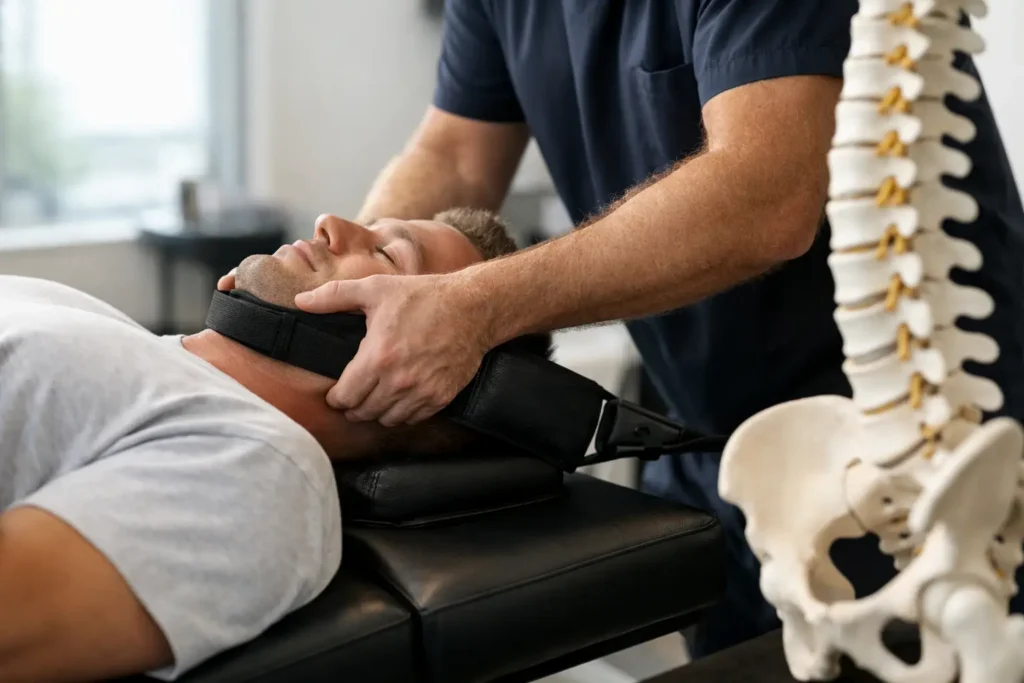
When people ask, is the ring dinger safe, they are usually not asking out of curiosity. They are asking because they have neck pain, back pain, pressure, headaches, or a feeling that their spine just is not moving the way it should. They want relief, but they also want to know whether a high-force spinal decompression technique is appropriate for their body.
That is the right question to ask.
The short answer is that the Ring Dinger® can be safe in the right hands, with the right patient, after the right evaluation. It is not a casual adjustment and it is not something that should be performed without careful clinical judgment. Safety depends less on the name of the technique and more on who is performing it, how thoroughly the patient has been screened, and whether the underlying condition actually makes that treatment appropriate.
Is the Ring Dinger safe in every case?
No. And that is exactly why a proper diagnostic process matters.
The Ring Dinger® is a long-axis spinal decompression and adjustment technique designed to create traction through the spine while the patient is positioned in a specific way. For some patients, that decompression can reduce pressure, improve mobility, and relieve pain patterns related to restriction and compression. For others, the same maneuver may be too aggressive, unnecessary, or simply not the best choice.
A clinically responsible answer is never that it is always safe or never safe. It depends on the patient’s anatomy, diagnosis, medical history, imaging findings, tissue tolerance, age, bone quality, neurological status, and treatment goals.
That is where specialist-level evaluation becomes essential.
What actually determines Ring Dinger safety?
The biggest factor is patient selection. A technique can be appropriate for one person and contraindicated for another. If a patient has severe osteoporosis, spinal instability, certain fractures, vascular risk factors, advanced disc pathology, post-surgical complications, or inflammatory conditions affecting the spine, a forceful decompressive maneuver may not be advisable.
On the other hand, a patient with mechanical spinal compression, restricted motion, chronic stiffness, and no red-flag findings may be a reasonable candidate if the exam supports it.
The second factor is the provider’s training and judgment. A Certified Team Ring Dinger® physician should not be treating the procedure as a performance or one-size-fits-all adjustment. It should be used as one clinical tool among many, not as the entire treatment plan.
The third factor is preparation. A thorough history, orthopedic and neurological examination, and when indicated, imaging review, help determine whether the spine can safely tolerate decompression. That is especially important in adults who have chronic pain, previous injuries, degenerative change, or a history of auto accidents.
Why screening matters before treatment
Patients often focus on the adjustment itself, but the most important part of safety happens before any hands-on treatment begins.
A proper screening process looks for signs that pain may be coming from something more complex than restricted movement. Numbness, weakness, radiating pain, gait changes, prior surgery, severe degeneration, connective tissue disorders, clotting risk, or vascular symptoms all change the safety picture. Even when treatment is possible, the technique may need to be modified or replaced with a lower-force option.
This is one reason board-certified Neuromusculoskeletal Medicine training matters. Musculoskeletal pain is not always simple. Neck pain may involve joints, discs, nerves, soft tissue, posture, trauma history, or a combination of factors. Low back pain may be driven by compression in one patient and instability in another. If you skip the diagnostic step, you increase the risk of applying the wrong treatment to the wrong problem.
Who may be a better candidate?
In general, patients who may tolerate this type of decompression better are adults with mechanical restriction, spinal stiffness, non-emergency disc-related pressure, chronic postural compression, and pain patterns that improve with unloading or traction. These patients often describe feeling compressed, tight, or stuck rather than unstable.
Some also have longstanding symptoms that have not responded well to medication or basic treatment approaches. In those cases, a more specialized manual medicine strategy may be helpful, especially when it is part of a broader plan that includes diagnostic clarity and follow-up care.
That said, even a patient who seems like a good candidate on paper may not be a good candidate in person. Examination findings always come first.
Who should be cautious or avoid it?
This is where honesty matters.
Patients with severe osteoporosis, known fracture risk, spinal instability, active inflammatory spinal disease, certain vascular concerns, advanced neurological compromise, recent surgery, or acute traumatic injury may need a different approach. The same goes for patients whose pain pattern suggests a condition that has not yet been properly diagnosed.
Older adults are not automatically excluded, but age alone does not answer the safety question. Bone density, tissue resilience, imaging findings, and overall health matter more than age by itself.
Patients with recent auto accident injuries also deserve careful evaluation. Trauma can create hidden instability, ligament injury, disc injury, or inflammatory irritation that makes force selection more complex. Sometimes decompression is helpful later in the recovery process. Sometimes it is not the first move.
Is the Ring Dinger safe compared with other spinal treatments?
That depends on what you are comparing it to.
Compared with surgery, a properly indicated manual decompression procedure is non-surgical and far less invasive. Compared with medication, it may address mechanics rather than just symptom suppression. Compared with generalized spinal manipulation, it is more specific in concept but can also be more intense in force and setup.
So the trade-off is straightforward. When it is indicated and performed correctly, it may offer meaningful relief for the right patient. When it is used too broadly, without appropriate screening, it can expose patients to unnecessary risk.
This is why thoughtful practices do not promise that one signature procedure is right for everyone. Good care is not built around a dramatic technique. It is built around matching the treatment to the diagnosis.
What should a safe Ring Dinger evaluation include?
If you are considering this treatment, the evaluation should feel clinical, not rushed.
You should expect a detailed conversation about your symptoms, prior injuries, medical history, surgeries, medications, imaging, and previous treatment responses. The physical exam should assess range of motion, neurological status, pain provocation, strength, reflexes, and areas of spinal restriction or instability. If there are warning signs, imaging or further medical workup may be needed before treatment is considered.
You should also receive a direct explanation of why the procedure is being recommended, what the expected benefits are, what the alternatives are, and why another option might be better if your case does not fit.
At Prather Neuromusculoskeletal Medicine, that diagnostic-first mindset is central to how more advanced spinal and decompression care should be delivered.
Signs you are in the right office
A safe environment does not start with a table or a technique. It starts with a provider who is willing to say no when a treatment is not appropriate.
Look for clinical reasoning, not sales language. Look for credentialing, exam findings, and a treatment plan that makes sense for your diagnosis. You want a physician or provider who can distinguish between compression, instability, disc irritation, nerve involvement, and soft-tissue dysfunction, because those are not treated the same way.
You should also feel that your concerns are being heard. A patient-focused practice does not dismiss fear. It explains the reasoning, outlines the risks and benefits, and adjusts the plan when needed.
The real answer to “is the ring dinger safe”
The real answer is that safety is earned through evaluation, training, diagnosis, and restraint.
For the right patient, the Ring Dinger® may be a safe and effective part of a non-surgical treatment plan. For the wrong patient, or in the wrong setting, it may be an unnecessary or unsuitable choice. That is not a contradiction. That is how responsible musculoskeletal medicine works.
If you are considering this kind of decompression, do not focus only on whether the procedure looks dramatic. Focus on whether your spine has been properly evaluated, whether the recommendation is based on your specific condition, and whether the provider has the clinical background to know when to use it and when not to.
The best treatment is not the most forceful one. It is the one that fits your diagnosis and moves you toward real relief with the least unnecessary risk.