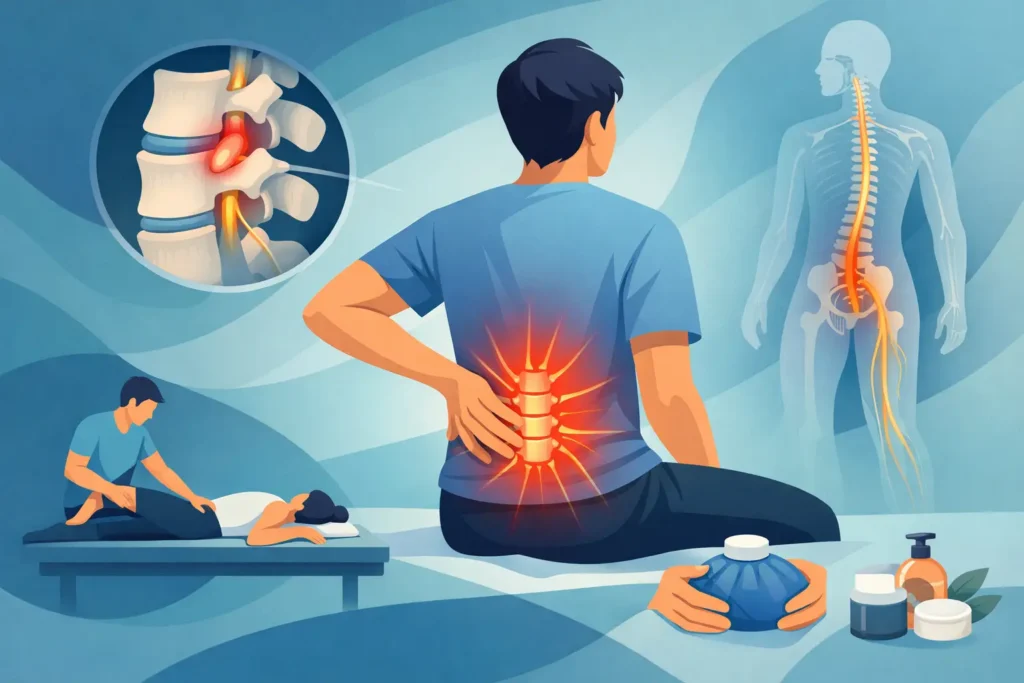
Pain that starts in the low back and travels into the buttock, thigh, calf, or foot is more than ordinary back soreness. For people asking how to relieve lumbar radiculopathy, the first priority is understanding why a spinal nerve is being irritated – then choosing treatment that reduces pressure, restores movement, and protects nerve function.
Lumbar radiculopathy is commonly called sciatica when symptoms travel down the leg, but not every case has the same cause or needs the same care. A disc bulge, disc herniation, spinal stenosis, arthritic narrowing, joint dysfunction, trauma from an auto accident, or inflammation around a nerve root can all create similar symptoms. The right plan depends on the source of the compression and the severity of neurological findings.
What Lumbar Radiculopathy Feels Like
A lumbar nerve root exits the spine and supplies sensation and muscle control to specific areas of the leg. When that nerve is compressed, inflamed, or mechanically stressed, symptoms may include sharp or burning pain, tingling, numbness, weakness, or a deep ache that runs below the knee. Coughing, bending forward, sitting for long periods, or lifting may intensify symptoms in some patients.
The location of symptoms can offer clinical clues. Irritation at one level may affect the front of the thigh, while another may cause pain along the outer leg or into the foot. Still, symptom patterns alone do not replace a careful examination. A diagnostics-driven evaluation should assess posture, gait, spinal motion, reflexes, strength, sensation, and the movements that reproduce or ease pain.
That distinction matters. Treating a nerve-root problem as simple muscle tightness can delay appropriate care. Conversely, a patient with severe pain but no progressive neurological loss may often improve with a conservative, non-surgical approach.
How to Relieve Lumbar Radiculopathy Without Guesswork
The most effective care is usually a staged plan rather than one isolated treatment. Early treatment aims to calm nerve irritation and prevent repeated aggravation. As symptoms settle, the focus shifts to restoring mobility, spinal mechanics, trunk control, and safe return to work, exercise, and daily activities.
Start with the right level of activity
Complete bed rest often makes back pain and stiffness worse. Short periods of rest may be reasonable during a severe flare, but prolonged inactivity can weaken supporting muscles and make ordinary movement feel more threatening. Controlled walking, frequent position changes, and gentle movements within a tolerable range are usually more useful than trying to “push through” severe leg pain.
Avoid the specific positions that consistently send symptoms farther down the leg. For one person, that may be prolonged sitting and bending; for another, it may be standing or extending backward. This is why generic internet exercises can be a poor fit. An exercise that helps one disc pattern may aggravate another.
Reduce mechanical stress on the nerve
Lumbar radiculopathy often has a mechanical component. Poor lifting technique, repetitive bending and twisting, long driving hours, deconditioning, and unresolved injury can keep stressing an already sensitive nerve root. Small adjustments can reduce that load: keep objects close when lifting, hinge at the hips rather than rounding the low back, avoid twisting while carrying weight, and break up seated work with brief movement intervals.
Sleep positions can also influence symptoms. Some patients are more comfortable on their side with a pillow between the knees; others prefer lying on their back with support beneath the knees. The goal is not a perfect universal posture. It is finding a position that allows the back and leg symptoms to settle instead of intensify overnight.
Use targeted manual medicine and decompression when appropriate
For properly selected patients, hands-on care can address restricted spinal motion, joint dysfunction, muscular guarding, and movement patterns that contribute to ongoing nerve irritation. In a specialized neuromusculoskeletal setting, treatment should follow a clinical assessment rather than a one-size-fits-all adjustment schedule.
Non-Surgical Orthopedic Decompression may be considered when disc-related compression or degenerative narrowing is contributing to symptoms. The purpose is to apply controlled traction and positioning that may reduce mechanical loading on affected spinal structures. It is not appropriate for every diagnosis, and results depend on factors such as the nature of the disc injury, degree of stenosis, symptom duration, and neurological status.
Manual procedures, including specialized spinal manipulation, also require sound judgment. They may be helpful in selected cases, but should be modified or avoided when examination findings, imaging, instability, fracture risk, or progressive neurological deficits indicate a different pathway. Good care is not defined by how forceful a treatment feels. It is defined by whether the treatment matches the patient’s condition and improves function safely.
Rebuild strength after the flare settles
Once acute symptoms are under better control, rehabilitation becomes essential. The low back does not work alone. Hip mobility, gluteal strength, abdominal endurance, balance, and movement coordination all affect the forces placed on the lumbar spine.
A clinician may prescribe progressive exercises that improve tolerance to walking, sitting, bending, and lifting without repeatedly flaring leg symptoms. This process should be gradual. A temporary increase in local back stiffness can happen as activity increases, but worsening numbness, spreading pain, or new weakness should not be ignored.
When Medication, Injections, or Surgery May Be Part of Care
Some patients need more than conservative care, especially when pain is severe or function is significantly limited. A physician may recommend anti-inflammatory medication, short-term pain control, or other medical options based on the patient’s health history. Medications can reduce symptoms, but they do not necessarily correct the mechanical cause of nerve compression.
Epidural injections may be considered when inflammation is a significant factor and pain prevents effective rehabilitation. They can provide a therapeutic window for movement and recovery, though relief varies and may be temporary. Surgery may become appropriate when there is progressive weakness, significant structural compression, loss of bowel or bladder control, or persistent disabling symptoms that have not responded to a well-directed conservative plan.
Coordinated care matters here. A non-surgical provider should recognize when specialized imaging, pain management, neurology, or surgical consultation is warranted. The goal is not to avoid surgery at all costs. It is to avoid unnecessary surgery while moving quickly when nerve function is at risk.
Red Flags That Need Immediate Medical Attention
Do not wait for a routine appointment if you develop new loss of bladder or bowel control, numbness in the groin or saddle area, rapidly worsening leg weakness, inability to walk safely, fever with severe back pain, or back pain after significant trauma. These symptoms can signal a serious condition requiring urgent medical evaluation.
Likewise, weakness deserves more attention than pain alone. Difficulty lifting the front of the foot, repeated tripping, inability to rise on the toes, or a noticeable loss of leg strength should be assessed promptly. Nerves recover best when significant compression is identified early.
A Personalized Path Back to Function
Lumbar radiculopathy can be disruptive, but it is not a diagnosis that should automatically lead to months of medication, inactivity, or an immediate surgical decision. A precise examination can identify whether symptoms are more consistent with disc involvement, spinal compression, joint dysfunction, trauma-related injury, or another neuromusculoskeletal cause. From there, treatment can be built around your actual findings, goals, and tolerance for care.
If leg pain, numbness, weakness, or recurring sciatica is limiting your life, Prather Neuromusculoskeletal Medicine offers a Complimentary NeuroSpinal Case Review to help determine the next appropriate step. Call 337-984-3113 or book online at www.prathernmm.com or www.louisianaringdinger.com to schedule. The right evaluation can replace uncertainty with a clear, patient-specific plan for safer movement and meaningful relief.