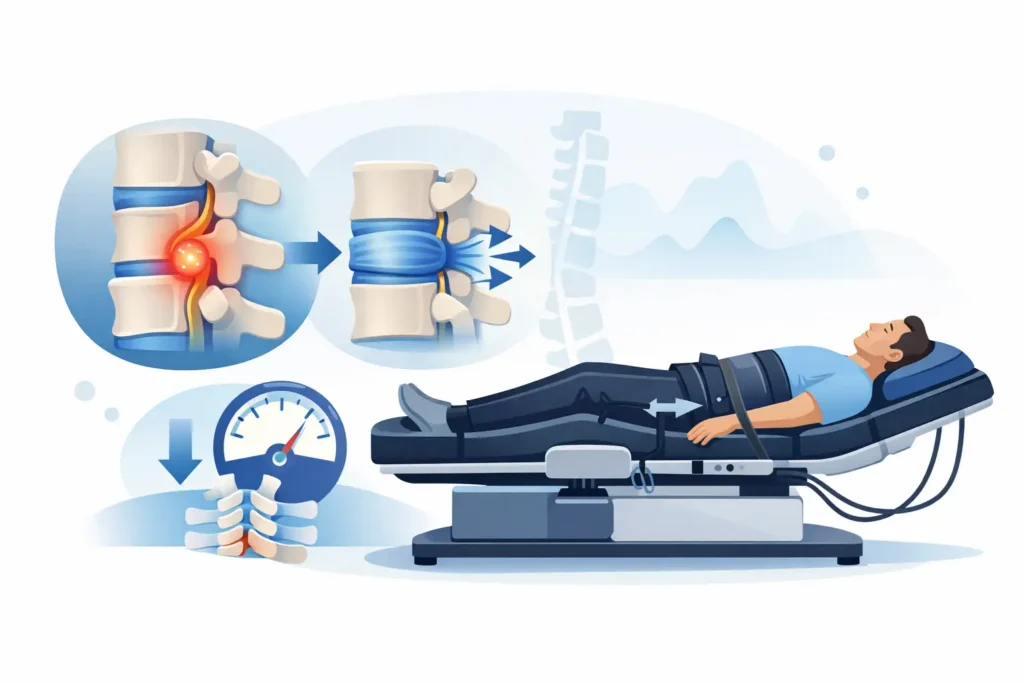
A disc problem is not always just a disc problem. When a spinal disc is under excess mechanical load, the surrounding joints, ligaments, muscles, and nerves often become involved as well. Understanding how orthopedic decompression reduces disc pressure helps explain why a careful, non-surgical approach may provide relief for people dealing with back pain, neck pain, sciatica, radiating symptoms, or stiffness after an injury.
At Prather Neuromusculoskeletal Medicine, treatment begins with identifying the source and pattern of dysfunction. Non-Surgical Orthopedic Decompression is not a one-size-fits-all treatment or a substitute for a thorough examination. It is a clinically directed method designed to reduce unfavorable spinal loading, improve motion, and create a better environment for irritated tissues to recover.
What Disc Pressure Means in the Spine
Spinal discs sit between the vertebrae and function as load-sharing cushions. Each disc has a resilient outer ring, called the annulus fibrosus, and a softer inner material, called the nucleus pulposus. Together, these structures distribute force during standing, bending, lifting, sitting, and walking.
Disc pressure rises when the spine is compressed, poorly positioned, repeatedly loaded, or unable to move normally. A long day of sitting with a flexed low back, a sudden lifting injury, repetitive twisting, joint degeneration, or the force of an auto accident can all alter how pressure is distributed through the spine. In some cases, the disc may bulge, protrude, or herniate. In others, pain comes from the disc’s outer fibers, nearby facet joints, tight protective muscles, or an irritated nerve root.
That distinction matters. An MRI finding alone does not determine the right care plan. Some disc bulges are painless, while a smaller injury can be highly symptomatic if it affects a sensitive nerve or occurs alongside joint restriction and muscle spasm. A proper neuromusculoskeletal evaluation connects imaging findings, examination results, symptom location, strength, reflexes, sensation, and movement tolerance.
How Orthopedic Decompression Reduces Disc Pressure
Orthopedic decompression uses controlled positioning and measured traction forces to gently separate spinal segments. Rather than simply pulling on the body, the goal is to create a specific mechanical effect at the involved region of the cervical or lumbar spine. This may reduce compressive loading across the disc and temporarily lower internal disc pressure.
When the vertebrae are carefully distracted, the disc space may gain room. That change can help reduce the mechanical stress placed on irritated disc fibers and nearby nerve structures. For a patient with leg pain from lumbar nerve irritation or arm pain associated with a cervical disc condition, reducing this stress may lessen the sensitivity that makes ordinary movement painful.
The treatment also aims to improve fluid exchange within the disc. Discs do not have the same direct blood supply as many other tissues. They rely in part on movement and pressure changes to exchange fluids and nutrients. Controlled decompression may support this exchange by alternating tension and relaxation, although results depend on the disc’s condition, the patient’s overall health, and the underlying cause of symptoms.
Just as important, decompression can reduce protective muscle guarding. When the body senses irritation or instability, muscles around the spine may tighten to limit movement. That response can be useful at first, but prolonged guarding may increase stiffness, alter posture, and add more compression. As pressure and pain sensitivity decrease, some patients can move more comfortably and begin restoring healthier mechanics.
Decompression Is More Than Stretching
General stretching can feel good, but it is not the same as clinically directed decompression. A decompression protocol considers the spinal level involved, the angle of pull, the amount of force, the patient’s position, and how symptoms respond during and after care. These details can influence whether treatment is helpful, neutral, or aggravating.
For example, a person with a lower lumbar disc issue may respond differently than someone with neck pain following whiplash. A patient with spinal stenosis, advanced degeneration, osteoporosis, prior fusion, acute fracture, infection, or certain vascular conditions may require a different approach or may not be an appropriate candidate for decompression. This is why diagnosis should come before treatment.
Why Nerve Symptoms Can Improve
A disc does not have to directly “pinch” a nerve to create severe symptoms. Inflammation, chemical irritation from disc material, swelling around the nerve root, and narrowing of the space where a nerve travels can all contribute to pain, tingling, numbness, burning, or weakness.
By reducing mechanical loading and improving space around the involved spinal segment, orthopedic decompression may decrease the ongoing irritation that keeps a nerve sensitized. It does not guarantee that every disc bulge will retract or that every symptom will disappear. However, for appropriate patients, a reduction in pressure can make it easier to sit, stand, sleep, walk, work, and participate in rehabilitation.
The clinical goal is not merely to make pain less noticeable for a few hours. It is to improve the conditions that allow the nervous system and musculoskeletal system to function with less strain.
Combining Decompression With a Personalized Care Plan
Disc pressure rarely develops in isolation. A patient may also have restricted spinal joints, weakened stabilizing muscles, altered gait, scar tissue after an injury, or poor tolerance for specific movements. For that reason, decompression is often most effective when it is part of a broader treatment plan.
Depending on the examination, care may include precise manual medicine, targeted spinal manipulation, soft-tissue treatment, movement recommendations, in-house imaging support, and guidance on modifying activities that are repeatedly aggravating the condition. The plan should be adjusted according to objective findings and the patient’s response, not according to a preset number of visits.
A hands-on, diagnostics-driven approach can be especially valuable after an auto accident. Whiplash, sudden braking forces, and impact injuries can affect the cervical spine, lumbar spine, discs, joints, and supporting soft tissues at the same time. Symptoms may not fully appear until days after the event, when inflammation and protective guarding increase.
What Patients May Feel During Treatment
Orthopedic decompression is generally designed to be gradual and controlled. Many patients describe a gentle pulling or unloading sensation rather than forceful pain. Some notice reduced pressure or easier movement after a session, while others experience a slower change over a series of treatments.
Response varies. Chronic disc degeneration may require a longer, more conservative care plan than a recent flare-up caused by lifting or prolonged sitting. If a treatment produces worsening radiating pain, new numbness, increasing weakness, or other concerning changes, the clinician should reassess the plan promptly.
Certain symptoms require urgent medical evaluation rather than routine decompression care. These include loss of bowel or bladder control, numbness in the groin or saddle area, rapidly progressing weakness, unexplained fever with severe spinal pain, or significant pain after major trauma. These signs can indicate a more serious condition that needs immediate attention.
A Better Question Than “Do I Have a Bulging Disc?”
Many patients arrive focused on one question: “Do I have a bulging disc?” A more useful clinical question is: “What is creating pressure, irritation, and loss of function in my spine?” The answer may include a disc, but it may also involve joint mechanics, nerve sensitivity, muscle imbalance, injury-related inflammation, or several factors at once.
That is why individualized assessment matters. The right non-surgical treatment is based on the person in front of the clinician, not just the wording of a radiology report. When decompression is appropriate, it can be a meaningful part of a plan to reduce spinal pressure, calm nerve irritation, and help restore confident movement.
If neck, back, arm, or leg symptoms are limiting your daily life, schedule a Complimentary NeuroSpinal Case Review with Prather Neuromusculoskeletal Medicine. Call 337-984-3113 or book online at www.prathernmm.com or www.prathernmsk.com to schedule. A clear diagnosis and a thoughtful plan can be the first step toward moving with less fear and more comfort.