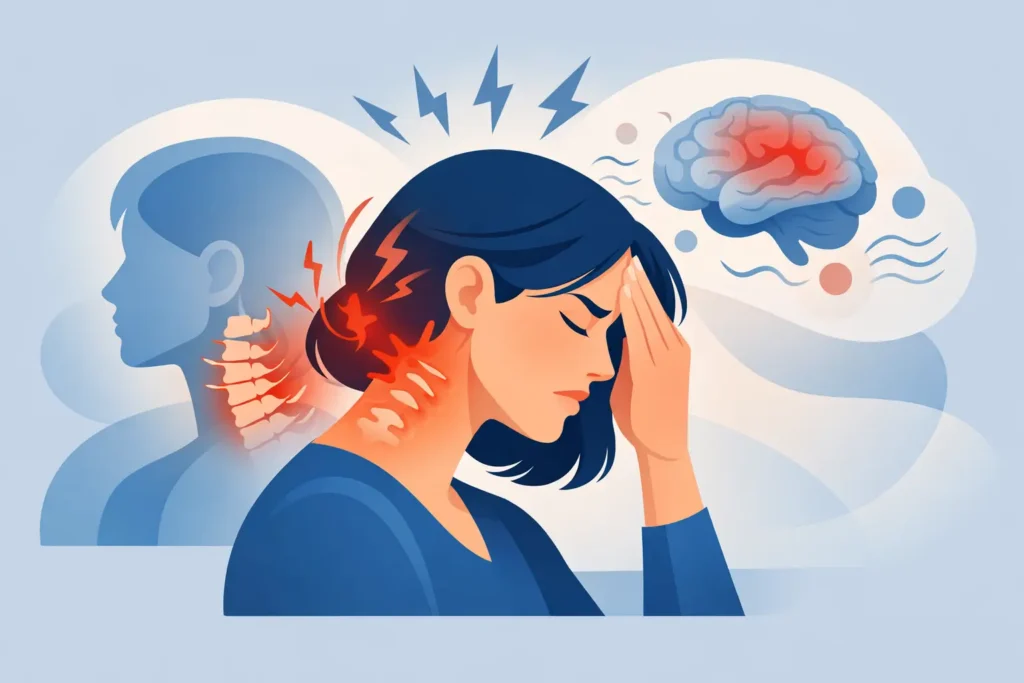
A headache that starts after a car accident is easy to dismiss at first. Many people assume it is just stress, a minor strain, or something that will fade once the soreness settles down. But if the pain keeps returning days or weeks after a whiplash injury, the question becomes very real: can whiplash cause chronic headaches? Yes, it can, especially when the neck joints, muscles, ligaments, discs, or nerves have been irritated and the underlying problem has not been properly identified.
Whiplash is not just a brief snap of the head backward and forward. It is a force injury to the cervical spine and surrounding soft tissues. Even when imaging does not show a fracture or major structural damage, patients can still develop persistent headache patterns tied to neck dysfunction. This is one reason post-accident headaches should not be brushed off as routine.
Can whiplash cause chronic headaches over time?
Yes. In many cases, whiplash-related headaches begin soon after an accident, but they do not always stay temporary. When cervical instability, joint restriction, muscle guarding, disc irritation, or nerve inflammation remains active, the headache can become recurrent or constant.
This happens because the neck and head are closely connected through muscles, nerves, and pain referral pathways. A problem in the upper cervical spine can produce pain that travels into the base of the skull, temples, forehead, or behind the eyes. Some patients describe pressure. Others report throbbing, burning, or a dull ache that worsens with work, driving, screen time, or sleeping in certain positions.
For some people, headaches improve with rest and time. For others, they persist because the original injury altered neck mechanics and left the tissues under ongoing strain. That is where a detailed Neuromusculoskeletal Medicine evaluation matters. If the root cause is still present, symptoms usually continue to cycle.
Why whiplash headaches can become chronic
After whiplash, the body often responds with inflammation, muscle spasm, and protective tension. That short-term response is normal. The problem starts when the neck does not recover its normal alignment, motion, and load distribution.
The cervical facet joints are a common source of post-whiplash headache pain. These joints can become irritated during the rapid acceleration and deceleration of an accident. When they remain inflamed or restricted, they may refer pain into the head. Upper cervical dysfunction is especially known for producing cervicogenic headaches, which are headaches caused by structures in the neck.
Soft-tissue injury also plays a major role. Strained muscles and ligaments can create tension through the back of the head and shoulders, while scar tissue and chronic guarding may limit normal movement. Some patients then change how they hold their head and neck, which adds more strain over time.
In other cases, a disc bulge, disc protrusion, or nerve irritation contributes to the headache picture. If there is compression, inflammation, or instability in the cervical spine, the pain pattern may become more complex and more resistant to simple measures like rest, stretching, or medication.
There is also a timing issue. Many accident patients feel adrenaline immediately after the crash and do not notice the extent of their symptoms until the next day or later that week. By then, the tissues are already inflamed, and the pain pattern may be more established.
What whiplash headaches usually feel like
Whiplash-related headaches do not look exactly the same in every patient. That is one reason self-diagnosis can be misleading. Still, there are some common patterns.
A cervicogenic headache often starts in the neck or at the base of the skull and moves upward. It may stay on one side or feel more intense on one side. Turning the head, looking down, prolonged sitting, or poor sleeping posture can aggravate it. Some people also notice neck stiffness, shoulder tension, reduced range of motion, dizziness, or pain between the shoulder blades.
Whiplash can also trigger tension-type headaches, especially when muscle spasm becomes chronic. These may feel like a tight band around the head. In some patients, a whiplash injury can aggravate migraine tendencies as well, which makes the clinical picture less straightforward.
That is why headache treatment should not be based only on the location of the pain. The driving question is what structure is generating it.
Signs the headache may be coming from the neck
When headaches are associated with neck pain, restricted motion, pain after an auto accident, worsening with certain head positions, or tenderness near the upper cervical region, the neck should be evaluated carefully. Patients often say, “My headache starts when my neck tightens up,” or “I can feel it building from the base of my skull.” Those details matter.
A clinically focused exam can help determine whether the headache is being referred from cervical joints, muscles, discs, or nerve irritation rather than arising as a primary headache disorder alone.
When to take chronic headaches after whiplash seriously
A persistent headache after an accident deserves attention even if the crash seemed minor. Vehicle damage does not always reflect what happened to the body. Low-speed collisions can still produce significant cervical strain.
You should be especially cautious if headaches are lasting more than a few days, becoming more frequent, interfering with concentration or sleep, or showing up with neck stiffness, numbness, radiating arm symptoms, dizziness, visual changes, or worsening pain with activity. Those signs suggest the issue may be more than temporary soreness.
Emergency symptoms such as sudden severe headache, fainting, major neurological changes, confusion, slurred speech, weakness, or signs of head injury require immediate medical attention. But even outside of emergencies, ongoing post-whiplash headaches should not be left to guesswork.
How the right diagnosis changes treatment
Many patients with chronic headaches have already tried medication, ice, heat, massage, or generalized therapy. Those measures may calm symptoms for a while, but if the real driver is cervical joint dysfunction, spinal compression, soft-tissue injury, or disc-related irritation, temporary relief is not the same as correction.
The best treatment depends on the cause. That may sound obvious, but it is where many patients get stuck. Headaches are often treated as a symptom only, while the injured cervical spine receives limited attention.
A proper evaluation should look at spinal biomechanics, cervical range of motion, referred pain patterns, orthopedic findings, neurological signs, and when appropriate, imaging support. This is especially important after auto accidents, where multiple tissue types may be involved at the same time.
If the headache is cervicogenic, treatment may focus on restoring motion, reducing joint irritation, addressing soft-tissue dysfunction, and improving how the cervical spine handles load. If there is decompression-related need, disc involvement, or nerve irritation, care may need to be more specific and progressive. If findings suggest something outside conservative care, coordination with the appropriate medical specialist may be necessary.
That clinical decision-making is what separates a generic approach from a patient-specific one.
Can chronic headaches improve without surgery?
Often, yes. Many whiplash-related headaches respond well to non-surgical care when the problem is identified early and treated with the right strategy. That does not mean every case resolves quickly. Some injuries are more complex, especially if treatment was delayed, the accident caused multiple spinal issues, or the patient has had prior neck problems.
Still, chronic does not automatically mean permanent. It means the condition has lasted long enough to require a more focused diagnostic and treatment plan.
Specialized manual medicine, targeted chiropractic procedures, non-surgical orthopedic decompression when indicated, and a structured plan based on findings can be effective for many patients dealing with post-accident neck pain and headaches. The key is not chasing pain from visit to visit. The key is identifying why the pain keeps returning.
Why patients often wait too long
People are busy. They go back to work, manage family responsibilities, and hope the headache will settle down on its own. Others have been told that if scans are “normal,” they should just rest and wait. But whiplash injuries often involve functional and soft-tissue problems that are very real even when the situation is not surgical.
The longer abnormal mechanics remain in the neck, the more likely the body is to build compensation around them. Over time, that can make headache patterns more entrenched and harder to resolve.
For patients in Lafayette and throughout the region who are dealing with headaches after an auto accident, an advanced, board-certified evaluation can help clarify what is happening and whether the pain is truly being driven by the cervical spine.
If you are still asking, can whiplash cause chronic headaches, and the pain has not gone away, it may be time to stop guessing. Prather Neuromusculoskeletal Medicine offers a Complimentary NeuroSpinal Case Review for patients seeking answers and non-surgical options. Call 337-984-3113 or book online at www.prathernmm.com or www.prathernmsk.com to schedule. A helpful next step is often the one that finally explains why the headache never really left.