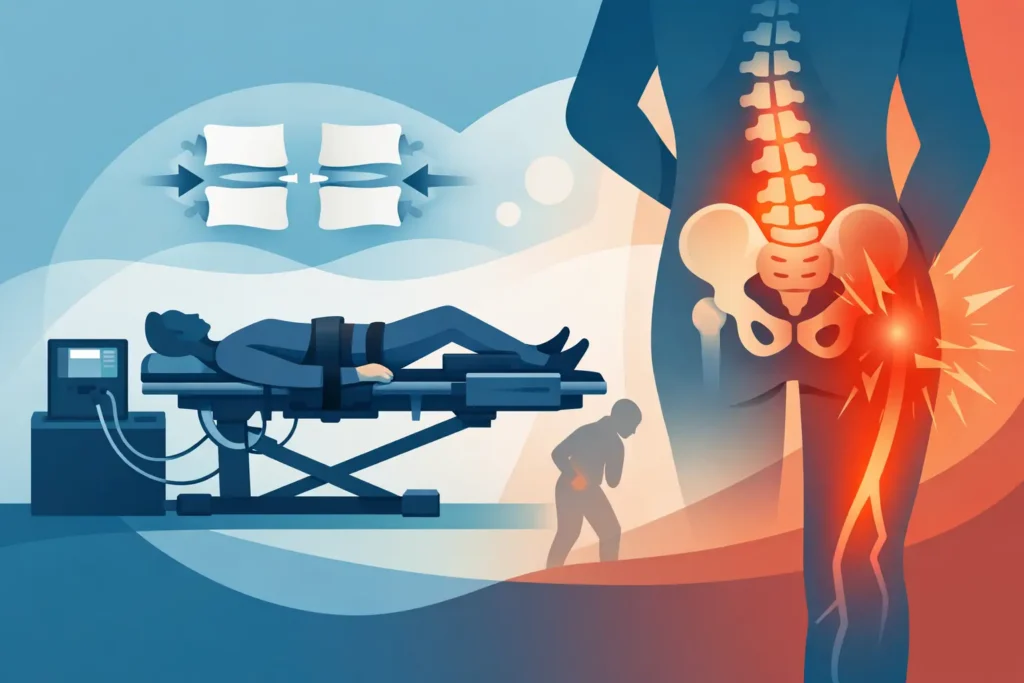
A sharp, burning pain that starts in the low back and travels through the buttock into the leg can make sitting, driving, sleeping, and working feel nearly impossible. Many patients ask, can decompression help sciatica when medication, rest, exercise, or standard care has not provided meaningful relief? For the right diagnosis and the right patient, non-surgical orthopedic decompression may be a valuable part of a focused treatment plan.
Sciatica is not simply “back pain.” It is a symptom pattern that occurs when the sciatic nerve or one of the nerve roots that contributes to it becomes irritated, inflamed, or compressed. Effective care starts by identifying why that nerve is under stress, rather than treating every case of radiating leg pain the same way.
Can Decompression Help Sciatica?
Spinal decompression can help some people with sciatica by gently reducing mechanical pressure within the lower spine. During a non-surgical decompression session, a controlled traction force is applied to the lumbar spine. The goal is to create a small pressure change within the disc and improve space around irritated nerve structures.
This may be particularly relevant when sciatica is associated with a lumbar disc bulge, disc protrusion, disc herniation, degenerative disc changes, or narrowing around a spinal nerve. By unloading the involved spinal segment, decompression may reduce pain with standing or sitting, lessen leg symptoms, and help a patient tolerate movement and rehabilitation more comfortably.
It is not a one-size-fits-all solution, and it should not be presented as a guaranteed cure. Sciatica can arise from several different conditions, including spinal stenosis, arthritic joint changes, muscle-related nerve irritation, instability, prior injury, or problems outside the spine. Decompression is most useful when clinical findings support a mechanical compression component that can reasonably respond to unloading.
A careful examination is what separates appropriate decompression care from generic traction. At Prather Neuromusculoskeletal Medicine, the objective is to determine whether the pain pattern, examination findings, imaging when needed, and functional limitations point toward a decompression-responsive condition.
What Decompression Can and Cannot Address
The lumbar discs act as shock absorbers between the bones of the spine. When a disc is injured or degenerates, it may lose height, develop a bulge, or allow disc material to irritate a nearby nerve root. That irritation can create pain, tingling, numbness, or weakness that runs down one leg and sometimes into the foot.
Non-Surgical Orthopedic Decompression is designed to address the mechanical environment around that area. It may reduce loading on an irritated disc and nerve while allowing the surrounding muscles and joints to move with less protective guarding. Patients commonly seek this approach because they want to reduce pain without immediately relying on injections, stronger medication, or spine surgery.
Still, decompression does not repair every source of leg pain. It will not correct a fracture, treat an infection, reverse severe neurologic damage, or replace surgery when surgery is clearly necessary. Patients with significant instability, certain spinal conditions, or advanced disease may need a different treatment approach. A credible provider should explain those distinctions clearly.
The goal is not merely to make a painful symptom quieter for a few days. The goal is to improve function – walking, sleeping, working, exercising, getting in and out of a vehicle, and returning to the activities that matter to you – while addressing the biomechanical factors contributing to nerve irritation.
When Sciatica Is More Likely to Respond
Decompression is often considered when leg symptoms are linked to disc-related or degenerative lumbar conditions and have persisted despite basic conservative measures. A patient may notice pain worsens with sitting, bending, lifting, coughing, prolonged driving, or transitions from sitting to standing. Others describe a feeling that their leg is “on fire,” weak, heavy, or difficult to trust while walking.
Response also depends on how long the problem has been present and whether the nerve is actively compromised. Newer symptoms may settle more readily than longstanding pain with extensive weakness or numbness. That does not mean chronic sciatica cannot improve. It means the treatment plan must be realistic, personalized, and built around measurable changes in pain, mobility, strength, and daily tolerance.
Auto accidents can also trigger or worsen disc and nerve symptoms. A collision may strain the lower back, aggravate preexisting degeneration, or reveal a disc problem that was previously manageable. In these cases, a detailed assessment is especially important because symptoms may involve more than one spinal region or injury pattern.
Why Treatment Usually Requires More Than a Table
A decompression session is most effective when it is part of a structured clinical plan rather than an isolated service. Depending on the patient’s condition, that plan may include targeted manual medicine, mobility work, stabilization strategies, posture and activity modification, and progressive movement recommendations.
Weight can also be a meaningful factor for patients with degenerative spine and joint pain. Excess load may make walking and exercise difficult while increasing strain on already sensitive structures. For patients who hurt too much to exercise effectively, non-invasive weight loss and fat reduction strategies may help support a more sustainable return to movement. The appropriate sequence depends on the patient: some need pain control first, while others need to improve overall conditioning alongside spine care.
What a Proper Sciatica Evaluation Should Include
Before beginning decompression, a clinician should take a thorough history and perform a focused neuromusculoskeletal examination. The pattern of pain matters. Pain extending below the knee, altered reflexes, sensory changes, muscle weakness, and pain with specific movements can provide important clues about the involved nerve level and the likely source of symptoms.
Your evaluation should also consider hip conditions, sacroiliac dysfunction, peripheral nerve irritation, vascular issues, and muscle disorders that can mimic sciatica. Not every pain in the buttock or leg is caused by a lumbar disc.
Imaging is not required for every episode of sciatica, particularly when symptoms are recent and there are no concerning findings. However, an MRI or other diagnostic study may be appropriate when symptoms are severe, persistent, progressive, associated with weakness, or being considered for more advanced treatment. Imaging should support clinical decision-making, not replace a hands-on examination.
A practical treatment plan should establish a baseline. How far can you walk? How long can you sit? Can you sleep through the night? Is numbness improving or spreading? These functional markers help determine whether care is delivering meaningful progress.
When Sciatica Requires Urgent Medical Attention
Most sciatica is not an emergency, but certain symptoms should never be managed by waiting for a routine appointment. Seek urgent medical evaluation for new loss of bowel or bladder control, numbness in the groin or saddle area, rapidly worsening leg weakness, fever with severe back pain, unexplained weight loss, or severe pain after major trauma.
Progressive weakness, such as a foot that begins to slap the ground or difficulty rising onto the toes, also requires prompt assessment. These signs may indicate significant nerve involvement and can change the treatment decision.
A More Deliberate Path Back to Movement
Sciatica can make people feel as if their body has become unpredictable. The answer is not always surgery, and it is not always decompression. The best next step is a precise diagnosis and a treatment plan built around the actual source of pain, your level of nerve involvement, and the life you want to return to.
If you are dealing with persistent sciatica, leg pain, disc-related symptoms, or mobility limits and want to explore a non-surgical approach, schedule an Orthopedic Decompression & Weight Loss Evaluation for $199. Call 337-984-3113 or book online at www.prathernmsk.com to schedule. A focused evaluation can help clarify whether decompression is appropriate and provide a clearer path toward moving with greater confidence.