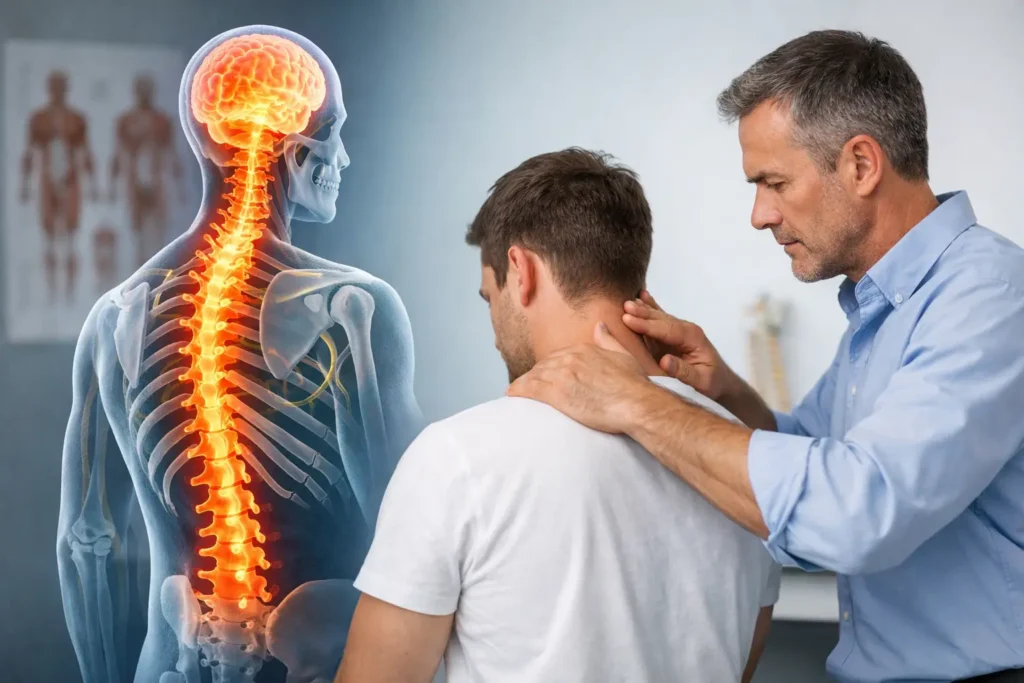
If you have been told your back pain is “just wear and tear,” your numb arm is “probably a pinched nerve,” or your joint pain is something you simply have to live with, it is reasonable to ask for a clearer answer. What is neuromusculoskeletal medicine? It is a specialized field focused on diagnosing and treating conditions that involve the nerves, muscles, joints, spine, and related soft tissues, with an emphasis on restoring function and reducing pain through skilled, hands-on care and biomechanical correction.
For many patients, the term sounds technical because it is. But the meaning is straightforward. “Neuro” refers to the nervous system. “Musculoskeletal” refers to the muscles, bones, joints, ligaments, tendons, and connective tissues that support movement. Neuromusculoskeletal medicine brings those systems together because pain rarely stays in one category. A spinal problem can irritate a nerve. A joint restriction can overload a muscle. Poor mechanics in the neck or low back can create symptoms that travel into the shoulder, arm, hip, or leg.
That is why this specialty matters. Instead of treating pain as an isolated complaint, neuromusculoskeletal medicine looks at how structure, motion, and nerve function interact.
What neuromusculoskeletal medicine actually treats
Neuromusculoskeletal medicine is centered on mechanical and functional disorders of the body. That includes neck pain, low back pain, sciatica, disc-related symptoms, headaches related to cervical dysfunction, shoulder pain, hip pain, knee pain, joint stiffness, muscle spasm, nerve irritation, and mobility loss.
It also applies to patients whose symptoms are more complicated than a simple strain. Some people have chronic pain that has lingered for months or years. Others have degeneration, spinal compression, recurrent flare-ups, or pain that has not responded well to medication, general chiropractic care, physical rest, or standard orthopedic advice. In those cases, a more detailed neuromusculoskeletal evaluation can reveal why symptoms keep returning.
This does not mean every painful condition is appropriate for manual treatment. Some patients need imaging, co-management, injections, surgery, or medical workup for systemic disease. A responsible neuromusculoskeletal medicine approach includes knowing when conservative care is the right path and when it is not.
How is neuromusculoskeletal medicine different from general chiropractic care?
This is one of the most common and most important questions. Neuromusculoskeletal medicine overlaps with chiropractic and manual medicine, but it is not simply a fancier name for routine spinal adjustment.
The difference is usually in the depth of diagnostic thinking, the scope of biomechanical assessment, and the clinical focus on complex pain patterns. A specialist in this area is trained to evaluate how nerves, joints, soft tissues, and movement dysfunction contribute to pain as a whole system. That often means a more detailed orthopedic and neurological examination, more attention to differential diagnosis, and a treatment plan built around the specific source of dysfunction rather than a one-size-fits-all series of adjustments.
In practical terms, a patient may come in with leg pain and assume the issue is in the knee. A neuromusculoskeletal evaluation may show that the real driver is lumbar disc irritation, altered gait mechanics, hip restriction, or nerve tension. Likewise, recurring shoulder pain may have less to do with the shoulder joint itself and more to do with cervical spine involvement, rib mechanics, or soft-tissue dysfunction.
That level of analysis matters because the right treatment depends on the right diagnosis.
What happens during a neuromusculoskeletal medicine evaluation?
The first visit is typically much more than a brief pain check. A proper evaluation looks at symptom history, aggravating and relieving factors, prior injuries, work demands, exercise habits, imaging if available, and the quality and pattern of pain.
Then comes the physical examination. This may include orthopedic testing, neurological screening, range-of-motion analysis, palpation of soft tissue and joint restrictions, postural assessment, and movement testing to identify where the body is compensating. If symptoms suggest disc involvement, nerve compression, instability, or a more serious condition, additional imaging or referral may be appropriate.
This diagnostic process is one of the defining features of the specialty. The goal is not to chase symptoms from one area to another. The goal is to identify the pain generator, the mechanical stress causing it, and the barriers preventing recovery.
What treatments are used in neuromusculoskeletal medicine?
Treatment depends on the diagnosis, not just the location of pain. Hands-on manual therapy is often central, but the method can vary significantly. Joint manipulation or mobilization may be used when restricted motion is contributing to pain or dysfunction. Soft-tissue treatment may help reduce muscular guarding, tissue tension, or movement imbalance. Some patients benefit from non-surgical orthopedic decompression when spinal compression, disc-related symptoms, or nerve irritation are part of the problem.
In a specialist setting, treatment is usually part of a broader plan rather than an isolated procedure. The intent is to improve mechanics, reduce irritation, restore more normal motion, and support healing without defaulting immediately to drugs or surgery.
That said, conservative care is not magic and it is not the answer for every case. Severe structural damage, progressive neurological loss, fracture, infection, or certain advanced degenerative conditions may require a different level of intervention. Good care includes that honesty.
Why the “neuro” part matters so much
People often focus on the musculoskeletal side of pain because that is what they feel – tightness, stiffness, soreness, instability. But nerve involvement is frequently what makes symptoms persistent, radiating, burning, tingling, or hard to predict.
When a disc bulges, a joint becomes inflamed, or surrounding tissues create compression, nerves can become irritated. Once that happens, symptoms may no longer stay local. Pain may travel. Strength may decline. Sleep may worsen. Simple movements may trigger exaggerated discomfort.
Neuromusculoskeletal medicine pays close attention to this relationship. A patient with hand numbness may have a wrist issue, a neck issue, or both. A patient with leg pain may have muscular tightness, but that tightness may be protective guarding around nerve irritation coming from the low back. Treating only the muscle in those cases can miss the reason the muscle keeps tightening up.
Who is a good candidate for this type of care?
Adults with persistent or recurring pain are often strong candidates, especially when the problem affects work, sleep, exercise, or daily activities. This includes active adults who want to stay mobile, professionals whose jobs aggravate spinal stress, and older patients trying to remain independent without escalating medication use.
It can also be a good fit for people who feel they have not been fully heard elsewhere. Many patients do not just want temporary relief. They want to understand what is causing the pain, what options are realistic, and whether there is a path that does not jump straight to invasive treatment.
The best results usually happen when the condition is mechanical, the diagnosis is clear, and the treatment plan is tailored to the individual. Duration of symptoms, severity of degeneration, overall health, and adherence to care all affect outcomes. In other words, it depends. Some people improve quickly. Others need a more gradual course of treatment and re-evaluation.
What to look for in a neuromusculoskeletal medicine provider
Credentials matter in this field. So does experience with complicated spine, joint, nerve, and soft-tissue conditions. Patients should look for a provider who performs a thorough diagnostic evaluation, explains findings clearly, and does not treat every condition with the same approach.
It also helps to find a practice that can identify when conservative care is appropriate and when collaboration with other medical specialists is necessary. That level of clinical judgment is especially important for patients who have had prior surgeries, advanced degeneration, worsening neurological symptoms, or failed treatment elsewhere.
At a practice such as Prather Neuromusculoskeletal Medicine, that specialist model is built around board-certified evaluation, hands-on treatment, and a focus on non-surgical solutions when they are clinically appropriate.
What is neuromusculoskeletal medicine really offering patients?
At its best, this specialty offers clarity. It gives patients a more precise explanation for why they hurt, why symptoms may be spreading or recurring, and what can be done to improve function safely.
It also offers a middle path that many people are looking for. Not every patient wants to rely on pain medication. Not every patient is ready for surgery. But they still want serious, clinically grounded care. Neuromusculoskeletal medicine fills that space by combining diagnostic discipline with hands-on, restorative treatment.
If your pain has been limiting how you move, work, or sleep, the right question may not be whether you can tolerate it longer. The better question is whether the cause of that pain has been fully evaluated by someone trained to see the whole mechanical and neurological picture.