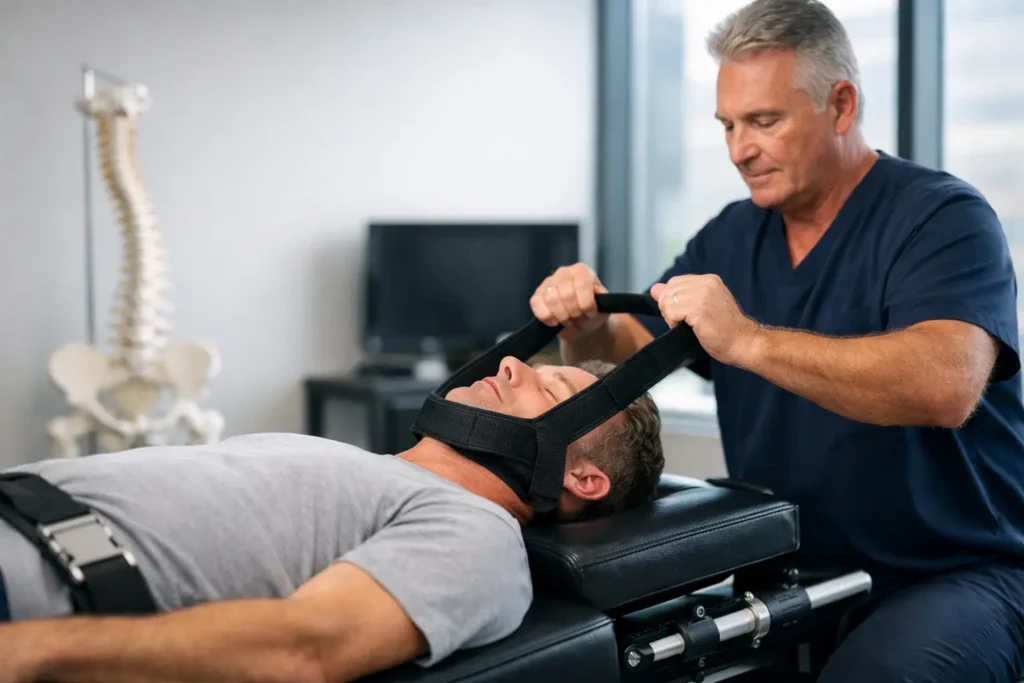
If you are searching for a ring dinger chiropractor, you are probably not looking for another generic adjustment. Most patients who ask about this technique have a reason – neck pressure, spinal stiffness, recurring headaches, nerve irritation, or the feeling that standard care has not addressed the real problem. The question is not just whether the technique looks dramatic. The real question is whether it is appropriate for your anatomy, symptoms, and diagnosis.
What a ring dinger chiropractor actually does
The Ring Dinger® adjustment is a specific spinal traction-based manual technique designed to create decompression through the spine. In simple terms, it combines a controlled setup with a targeted pulling force to help reduce compression across spinal segments. Patients often seek it out because they want relief from pressure, restricted motion, and symptoms that may be related to spinal dysfunction.
That said, this is not a one-size-fits-all maneuver. A skilled Ring Dinger® provider should not begin with the technique itself as the main event. The starting point should be a thorough clinical evaluation, review of symptoms, physical examination, and when needed, imaging or further diagnostic workup. In a specialty Neuromusculoskeletal Medicine setting, the technique is one possible tool within a broader treatment plan, not a shortcut around diagnosis.
Why patients look for a ring dinger chiropractor
Many patients pursuing this form of care are dealing with more than routine back or neck soreness. They may have chronic spinal compression, postural breakdown, reduced cervical or thoracic mobility, pain after an auto accident, or symptoms that radiate into the shoulders or arms. Others are active adults who feel increasingly limited by stiffness or older patients trying to avoid medications, injections, or surgery if a non-invasive path is still reasonable.
The appeal is understandable. When the spine is compressed or not moving well, patients often describe a sense of pressure, heaviness, or restriction that standard approaches have not fully changed. A decompressive adjustment can sound promising because it aims at mechanical load and motion loss. For the right patient, that focus can matter.
But expectations should stay grounded in medicine, not marketing. A ring dinger chiropractor is not treating a video clip. The goal is not to create a dramatic sound or moment. The goal is to improve function, reduce pain generators, and support a safer mechanical environment for healing.
Ring dinger chiropractor care is not for everyone
This is where expertise matters most. Some patients may be good candidates for a traction-based spinal adjustment. Others may need a different manual technique, orthopedic decompression, soft-tissue treatment, rehabilitative support, or referral for co-management. In some cases, the technique may not be appropriate at all.
That depends on several factors, including bone quality, disc status, history of fracture, spinal instability, severe degeneration, prior surgery, inflammatory conditions, vascular concerns, or acute neurologic findings. Even when a patient wants a specific treatment, the responsible decision may be to modify the approach or avoid that technique entirely.
A clinically oriented practice should be comfortable saying no when no is the right answer. That is not a limitation. It is a sign that patient safety and diagnostic accuracy come first.
Why diagnosis comes before treatment
A lot of musculoskeletal pain feels similar from the patient side. Neck pain can come from disc involvement, facet irritation, muscle guarding, ligament injury, nerve compression, postural overload, or a combination of issues. Low back pain can reflect joint dysfunction, spinal stenosis, degeneration, soft-tissue strain, or referred pain patterns. The same symptom does not always call for the same intervention.
That is why board-certified Neuromusculoskeletal Medicine has real value in this setting. It brings a more detailed diagnostic framework to manual care. Instead of assuming all spinal pain should be adjusted in the same way, the physician evaluates structure, nerve involvement, biomechanics, and functional limitations before deciding what type of treatment is medically appropriate.
For patients who have already tried routine chiropractic care, medications, or rest without enough progress, this deeper level of assessment can be the difference between temporary symptom changes and a more precise plan.
What to expect at your appointment
A proper evaluation should feel methodical, not rushed. You should expect questions about where your pain begins, how it behaves, whether it travels, what makes it worse, what previous care has helped or failed, and whether there are warning signs such as weakness, numbness, dizziness, or trauma history. Examination should look at spinal motion, joint restriction, muscle tension, neurologic findings, posture, and mechanical loading patterns.
If a Ring Dinger® adjustment is considered, it should be explained clearly. You should understand why it is being recommended, what it is intended to address, and what alternatives exist. In many cases, the best care plan includes more than one service. Manual manipulation may be paired with Non-Surgical Orthopedic Decompression, soft-tissue treatment, follow-up reassessment, or referrals when a surgical or neurological opinion is needed.
The right practice does not force every patient into the same protocol. Personalized care means the treatment matches the diagnosis, not the other way around.
Benefits and limits of the Ring Dinger® technique
For properly selected patients, traction-based spinal adjustment may help reduce the sensation of compression, improve mobility, and ease pain tied to mechanical restriction. Some patients report less tension, better range of motion, fewer headaches, or a decrease in radiating symptoms after care. It can be especially meaningful for people who feel compressed, locked up, or functionally limited.
Still, there are limits. No manual treatment fixes every cause of pain. If symptoms are being driven by advanced structural pathology, severe inflammatory disease, unstable injury, or conditions outside the mechanical spine, another treatment path may be needed. Even in good candidates, results vary. Some patients improve quickly, while others need a series of visits and supportive therapies to achieve durable relief.
This is the trade-off patients deserve to hear honestly. A ring dinger chiropractor may offer a powerful option for spinal decompression, but the technique works best when placed inside a thoughtful, diagnosis-first care model.
Choosing the right provider
Credentials matter here. When a treatment involves high-level spinal traction and patients may present with complex pain patterns, advanced clinical judgment is essential. Look for a provider who can evaluate more than joint restriction alone – someone trained to assess nerves, muscles, soft tissues, orthopedic findings, and whether the patient belongs in conservative care at all.
This is especially important for patients with chronic pain, accident injuries, degenerative changes, or symptoms that have not responded to standard treatment. A specialist approach should include clear communication, appropriate caution, and a willingness to coordinate with imaging centers, surgeons, or other medical professionals when needed.
At Prather Neuromusculoskeletal Medicine, that philosophy centers on root-cause diagnosis and non-surgical care that is both hands-on and clinically grounded. For patients seeking a Ring Dinger® physician, that combination of specialized manual treatment and medical decision-making is often what they were missing in prior care.
When to seek an evaluation
If you are dealing with persistent neck or back pain, pressure through the spine, restricted motion, headaches connected to neck tension, symptoms after an auto accident, or recurring nerve irritation, it may be time for a more specialized assessment. The best next step is not guessing whether one technique will solve it. It is finding out what is actually driving your pain.
That answer may lead to a Ring Dinger® adjustment. It may lead to another form of manual medicine, decompression, or a more coordinated treatment plan. Either way, the value is in getting care that matches your condition with precision.
Relief is more likely when the treatment is chosen for the right reasons, delivered by the right hands, and guided by a diagnosis you can understand.