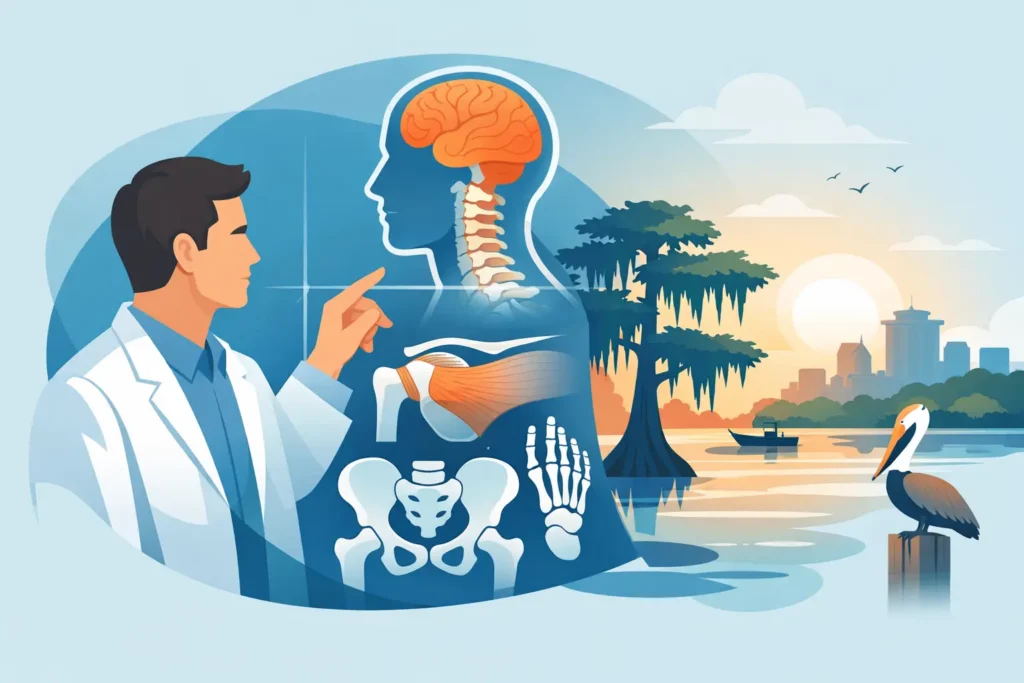
Back pain that keeps returning, headaches that start in the neck, numbness down the arm, sciatica that flares when you sit – these problems are rarely as simple as “just a sore muscle.” If you are searching for a neuromusculoskeletal medicine doctor Louisiana patients can turn to for a more precise answer, it helps to understand what this specialty actually does and why it can matter when standard care has not solved the problem.
Neuromusculoskeletal Medicine focuses on how the nerves, muscles, joints, spine, connective tissues, and movement patterns work together. That sounds technical because it is. But for patients, the real value is straightforward: a better diagnosis, a more hands-on evaluation, and a treatment plan built around the cause of pain rather than only the symptom.
What a neuromusculoskeletal medicine doctor does
A neuromusculoskeletal medicine doctor evaluates pain and dysfunction through both medical reasoning and manual assessment. That means the exam is not limited to where it hurts. It often includes how the spine moves, whether a joint is restricted, whether a disc injury may be irritating a nerve, whether the surrounding muscles are compensating, and whether old injuries have changed the way the body loads and stabilizes.
This approach is especially useful for patients whose symptoms cross categories. A person may say they have low back pain, but the real clinical picture could involve lumbar disc strain, nerve irritation, pelvic imbalance, protective muscle spasm, and reduced mobility all at once. If only one piece gets treated, the pain may improve briefly and then return.
That is one reason this field stands apart from more routine, symptom-based care. It is designed to connect structure with function. In practical terms, that can help explain why one patient has neck pain with headaches, another has shoulder pain that is really coming from the cervical spine, and another has leg pain that is being driven by lumbar compression rather than a local muscle issue.
Why patients seek a neuromusculoskeletal medicine doctor in Louisiana
Many patients do not begin their search with this specialty in mind. They begin with a problem that has not improved. Sometimes they were told to rest and wait. Sometimes they tried medications that reduced pain temporarily but did not change the underlying mechanics. Sometimes they had general manipulation, injections, or physical therapy without a clear explanation of why symptoms kept returning.
A neuromusculoskeletal medicine doctor in Louisiana may be the right next step when pain is persistent, mechanically driven, or connected to injury. This is often true after auto accidents, whiplash, lifting injuries, sports strain, repetitive work stress, or long-standing spinal compression.
The goal is not to force every patient into the same treatment. It is to determine whether the problem is best addressed with manual medicine, decompression, co-management, imaging, referral, or a combination of those options. That distinction matters. Good care is not about doing more treatment. It is about doing the right treatment for the diagnosis.
Conditions this specialty commonly evaluates
Patients are often surprised by how many complaints fall under neuromusculoskeletal care. Neck pain, low back pain, mid-back pain, headaches, arm numbness, sciatica, joint stiffness, whiplash, disc bulges, disc protrusions, herniated discs, muscle spasm, postural strain, and mobility loss can all involve neuromusculoskeletal dysfunction.
Some cases are acute and obvious. A car accident patient may develop cervical sprain, lumbar strain, radicular pain, and limited rotation almost immediately. Other cases build slowly. A person with years of desk work, old injuries, and reduced spinal motion may not notice the pattern until headaches, tingling, and sleep disruption become hard to ignore.
There is also an important difference between pain and damage. Severe pain does not always mean severe structural injury, and mild pain does not always mean the condition is minor. That is why a careful examination matters. The treatment plan should be driven by findings, not guesses.
The difference between generalized treatment and specialist-level evaluation
When patients hear “manual medicine,” they sometimes assume all approaches are interchangeable. They are not. The training, diagnostic depth, and clinical reasoning behind treatment can vary significantly.
A specialist in Neuromusculoskeletal Medicine is trained to assess biomechanics, neurologic involvement, joint dysfunction, soft-tissue restriction, and spinal mechanics as part of a broader medical framework. That can be particularly important for patients who are trying to avoid unnecessary surgery but also do not want casual reassurance without answers.
There are trade-offs here. Not every condition can be resolved with conservative care. Some patients need imaging before treatment. Some need orthopedic or neurosurgical consultation. Some do best with a combined plan that includes manual treatment, decompression, and medical coordination. The value of specialist care is not that it promises one answer for everyone. The value is that it helps sort out which path makes clinical sense.
How non-surgical care may help
For the right patient, non-surgical treatment can reduce pain, improve movement, relieve nerve pressure, and restore daily function. That may involve precise manual manipulation, soft-tissue treatment, mobility restoration, and non-surgical orthopedic decompression when disc or spinal compression is part of the problem.
The best results usually come when treatment matches the actual pain generator. If a disc injury is driving nerve irritation, strengthening alone may not be enough early on. If a joint restriction is overloading surrounding muscles, medication may dull pain without changing the dysfunction. If whiplash has altered cervical mechanics, waiting for it to “settle down” may leave the patient with chronic headaches and stiffness.
That is also why timeline matters. New injuries and older injuries do not behave the same way. Acute inflammation, chronic degeneration, scar tissue, compensation patterns, and deconditioning each change how a case should be managed.
Auto accident injuries need a closer look than many patients realize
One of the most common reasons patients seek advanced musculoskeletal care is after a motor vehicle collision. Even a low-speed crash can create significant force through the neck, low back, shoulders, and supporting soft tissues. Whiplash is not merely soreness. It can involve ligament strain, muscle guarding, altered cervical curvature, headache patterns, nerve irritation, dizziness, and limited mobility.
What complicates these cases is that symptoms do not always appear immediately. A patient may feel manageable discomfort the first day and then develop increasing pain, stiffness, and neurologic symptoms over the next several days. That delay sometimes causes people to underestimate the injury.
A thorough neuromusculoskeletal exam can help identify whether symptoms are consistent with sprain-strain injury, joint dysfunction, disc involvement, or nerve irritation. That is a very different process from simply being told to monitor symptoms and take pain relievers.
What to expect from a more diagnostics-driven visit
A proper evaluation should feel detailed, not rushed. Patients should expect questions about when symptoms started, what makes them worse, whether the pain travels, whether there is numbness or weakness, and whether prior treatment changed anything. The physical exam may include range of motion, neurologic testing, orthopedic testing, posture, gait, palpatory findings, and targeted assessment of the involved region.
If imaging is needed, that decision should be based on clinical findings. If treatment begins, it should be explained clearly. Patients deserve to know what is being treated, why it is being treated, and what progress should look like over time.
That level of clarity matters because pain can be discouraging. Many patients have already spent months adapting their work, sleep, exercise, and family life around symptoms. A focused plan gives them something they often have not had before – direction.
When it is time to stop waiting
If your pain keeps returning, if your injury never fully healed, or if you feel caught between medication and surgery, this is usually the moment to get a more advanced evaluation. The earlier the mechanics are identified, the better the chance of restoring function before compensation patterns become more entrenched.
For patients dealing with spinal pain, disc injury, headaches, whiplash, sciatica, nerve symptoms, or unresolved musculoskeletal dysfunction, specialist care can offer a more precise path forward. At Prather Neuromusculoskeletal Medicine, patients can begin with a Complimentary NeuroSpinal Case Review to discuss their condition and next steps. Call 337-984-3113 or book online at www.prathernmm.com or www.prathernmsk.com to schedule. Relief often starts when the problem is finally identified correctly.