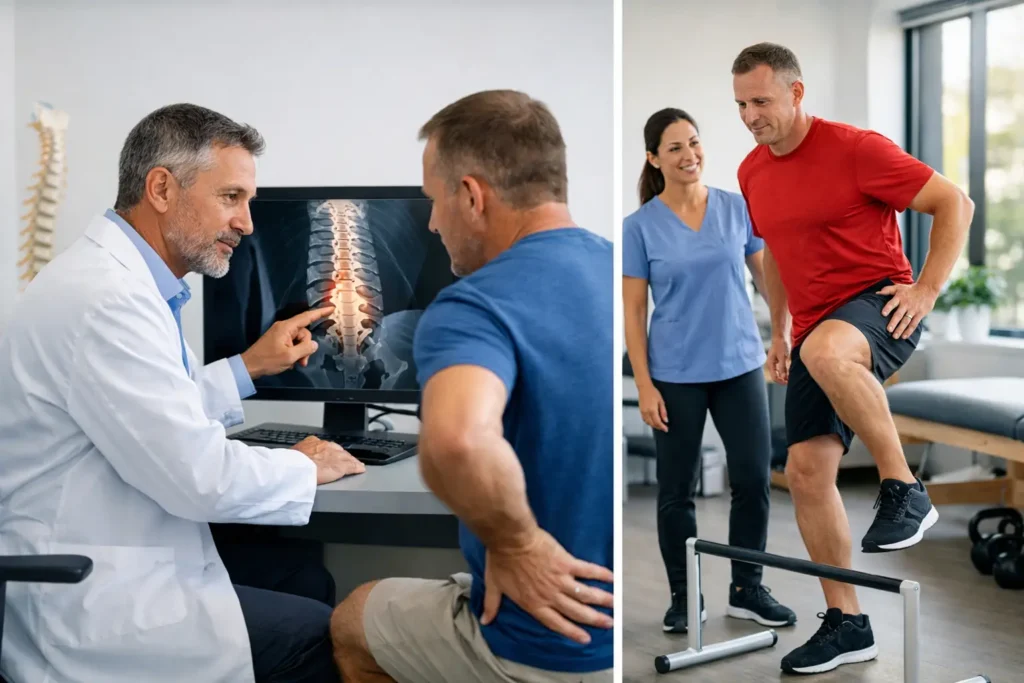
Back pain that travels into the buttock, leg, foot, shoulder, or arm is often described as a “disc problem.” Sometimes that description is accurate. Other times, it overlooks the actual source of symptoms. Effective Louisiana disc injury treatment begins with determining whether a spinal disc is truly responsible for the pain, whether a nerve is involved, and what functional problem is keeping the condition from improving.
A disc finding on an MRI can be meaningful, but it is not automatically the diagnosis. Many adults have disc bulges, degeneration, or small herniations without pain. Conversely, a patient may have significant leg pain, numbness, or weakness even when imaging findings appear modest. The clinical question is not simply, “What does the scan show?” It is, “Does the scan match the patient’s symptoms, examination findings, movement limitations, and pattern of disability?”
For patients who have completed therapy, tried medication, received injections, or been advised to consider surgery without clear improvement, a more comprehensive neuromusculoskeletal evaluation can provide needed direction.
Understanding a Disc Injury
Spinal discs are the cushions between the bones of the neck and low back. Their outer layer is made of durable fibrous tissue, while the center has a softer, gel-like material that helps distribute load. A disc can become painful or clinically relevant in several ways, including a tear in the outer fibers, a bulge, a herniation, or progressive loss of disc height.
The term “disc injury” is broad. A disc may cause pain locally in the back or neck, but it can also irritate or compress a nearby nerve root. In the low back, this may create pain that travels down the leg, often called sciatica. In the neck, it can cause pain, tingling, numbness, or weakness into the shoulder, arm, or hand.
Still, not every symptom that travels is caused by a disc. Hip disorders, sacroiliac joint dysfunction, peripheral nerve entrapment, muscle injury, spinal stenosis, and other conditions can create similar complaints. This is why treatment based only on an MRI report may miss the mark.
When Louisiana Disc Injury Treatment Requires More Than an MRI
Imaging is valuable, particularly when symptoms are severe, persistent, associated with neurologic changes, or not responding as expected. Yet imaging is one component of a clinical decision, not a substitute for a careful examination.
A physician-level evaluation should consider where symptoms begin, where they travel, which positions worsen or ease them, and whether coughing, bending, sitting, walking, or extension changes the pain. The examination may assess strength, reflexes, sensation, gait, joint motion, muscle control, nerve tension, and the mechanical movements that reproduce symptoms.
This process matters because a disc bulge on the right side of the low back should not be assumed to explain left-sided symptoms. Likewise, a small disc abnormality may be important if it matches a highly specific neurologic examination. The goal is to identify the pain generator and the functional impairments surrounding it, rather than treating an image.
Symptoms That Deserve Prompt Medical Attention
Most disc-related pain can be evaluated thoughtfully without panic. However, certain symptoms require urgent medical assessment. These include new or worsening loss of strength, difficulty walking because of weakness, loss of bowel or bladder control, numbness in the groin or saddle area, fever with severe spinal pain, or severe pain following major trauma.
These signs do not necessarily mean a person will need surgery, but they should not be managed through watchful waiting alone. Prompt evaluation helps protect neurologic function and clarify the appropriate next step.
A Non-Surgical Treatment Plan Should Match the Diagnosis
There is no single treatment that is appropriate for every disc condition. The best plan depends on the location of the disc problem, the degree of nerve involvement, symptom duration, movement intolerance, neurologic findings, prior treatment response, and the patient’s goals.
For some patients, a focused rehabilitation plan is appropriate. This is different from simply repeating exercises that have already failed. Therapy should be guided by a working diagnosis and adjusted according to measurable changes in pain, strength, tolerance for sitting or walking, and daily function. A person whose symptoms worsen with flexion, for example, may require a different strategy than someone whose symptoms are aggravated by standing or extension.
Medication may have a limited but useful role in controlling acute inflammation, muscle spasm, or nerve-related pain. It should support recovery and function, not become the entire plan. Similarly, targeted procedures may be considered when the clinical findings identify a specific pain source and the potential benefits justify the risk.
In selected cases, Non-Surgical Orthopedic Decompression may be considered as part of a physician-directed plan. It is not a universal solution for every disc bulge or episode of back pain. Its appropriateness depends on the diagnosis, symptom pattern, physical examination, imaging correlation, and the patient’s ability to tolerate treatment. Careful selection is more valuable than applying the same intervention to everyone with an MRI finding.
Why Previous Treatment May Not Have Helped
When a patient has not improved after conventional care, it does not automatically mean the condition is untreatable. Often, it means the diagnosis needs to be revisited or the treatment strategy was too general for the complexity of the case.
A patient may have a disc-related condition plus hip dysfunction, significant nerve sensitivity, deconditioning after months of guarded movement, or a separate pain generator that was never identified. Another patient may have been treated for a disc issue when the primary source was actually outside the spine. These distinctions affect the treatment plan and the likelihood of meaningful progress.
Persistent pain can also change movement patterns. People begin avoiding bending, rotating, climbing stairs, sitting, or sleeping in certain positions. Over time, this can create secondary muscle guarding, loss of conditioning, and reduced confidence in movement. Addressing these consequences does not mean dismissing the original injury. It means treating the full clinical picture.
When Is Surgery Considered?
Surgery can be appropriate for certain disc injuries, especially when there is progressive neurologic weakness, severe nerve compression that has not responded to appropriate conservative care, or symptoms that remain substantially disabling despite a well-directed treatment plan. It can be an important option when the indication is clear.
At the same time, surgery is not determined by MRI findings alone. Many patients reasonably seek a specialty opinion before proceeding, particularly when symptoms are complex, the diagnosis remains uncertain, or prior treatments have not produced a clear response. A non-surgical evaluation can help clarify whether additional conservative options are appropriate or whether a surgical consultation is the more prudent next step.
The purpose of specialty care is not to delay necessary surgery. It is to ensure that the decision is based on a complete understanding of the condition, the neurologic findings, and the patient’s goals.
What a Comprehensive Evaluation Should Provide
Patients with persistent neck or back pain deserve more than a generic label and a list of routine options. A thorough evaluation should provide a clear explanation of what appears to be causing symptoms, what remains uncertain, and why a particular treatment plan is being recommended.
It should also establish measurable goals. Depending on the patient, progress may mean walking farther, sitting through work without escalating pain, returning to exercise, sleeping more comfortably, reducing medication reliance, or restoring confidence in daily movement. Pain reduction matters, but function is often the more meaningful measure of recovery.
For complex cases, careful clinical reasoning can be especially valuable. At Prather Neuromusculoskeletal Medicine, patients receive individualized physician-guided evaluation for difficult spine, nerve, joint, and movement disorders, including cases that have not responded to conventional care.
If disc-related pain is limiting your work, family life, sleep, or ability to move with confidence, schedule a complimentary Virtual Consultation – Case Evaluation with Dr. Eric Prather. Call 337-984-3113 or book online at www.prathernmsk.com to determine whether your case is appropriate for specialty evaluation. The right next step is not always more treatment. Sometimes it is a more precise answer.