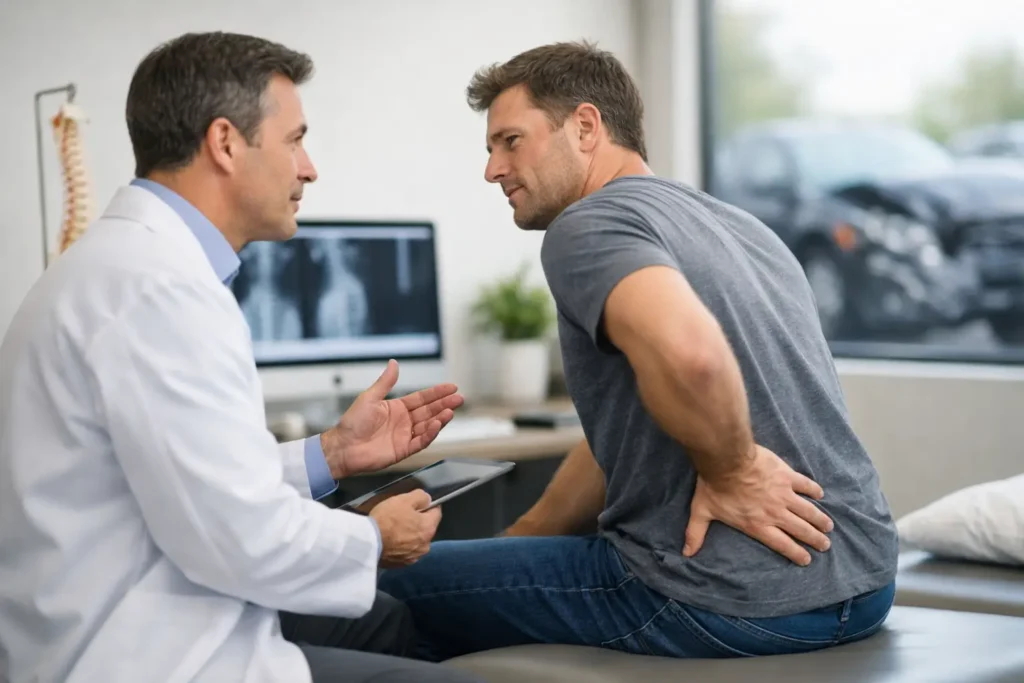
A collision can be over in seconds, yet Lafayette car accident back pain may not become clear until the next morning, after a return to work, or when a simple movement such as getting out of bed suddenly feels different. That delay can be confusing. It does not automatically mean a serious injury is present, but it does mean the pain deserves thoughtful attention, especially when it limits normal activity or fails to improve.
Back pain after a motor vehicle accident is not a single diagnosis. The same force that leaves one person with a short-lived muscle strain may leave another with irritated spinal joints, a disc-related problem, a nerve injury, or a change in how the body moves to protect an injured area. The useful question is not simply, “Where does it hurt?” It is, “What structures were affected, and why is this symptom continuing?”
Why Back Pain Can Start After the Accident
During a collision, the body is exposed to rapid acceleration, deceleration, rotation, or compression. Seat belts, airbags, headrests, and vehicle design reduce the risk of severe injury, but they cannot prevent every strain on the spine and surrounding tissues. Even a lower-speed crash can be physically significant when the body is twisted, braced against the steering wheel, or struck from an unexpected direction.
Adrenaline can initially mask pain. In the hours after an accident, people often focus on the vehicle, their family, or the immediate logistics of the event. As that stress response settles, stiffness and soreness can become more noticeable. Inflammation may also develop over the next several days.
This delayed pattern is common with soft-tissue injuries, but it should not lead to assumptions. Persistent pain can reflect more than a strained muscle. A careful evaluation considers the mechanism of the crash, the location and quality of symptoms, prior injuries, physical examination findings, and whether there are signs of nerve involvement.
Common Sources of Lafayette Car Accident Back Pain
The low back is particularly vulnerable because it transfers force between the upper body and pelvis. Pain may arise from muscles and ligaments that were suddenly stretched, from the small joints in the spine, or from the sacroiliac joints where the spine meets the pelvis. These conditions can overlap, which is one reason a generalized diagnosis of “back strain” does not always explain a difficult recovery.
Muscle and ligament injury
A strain or sprain can cause aching, tightness, spasm, and pain with bending, twisting, standing, or changing positions. Many people improve steadily with appropriate activity modification and guided rehabilitation. However, prolonged guarding can create movement compensations. The body may begin avoiding one side, tightening surrounding muscles, or loading the hips differently, allowing pain to persist beyond the original injury.
Spinal joint or sacroiliac joint pain
Spinal facet joints and sacroiliac joints can become irritated after a forceful impact. Joint-based pain is often more localized than nerve pain, though symptoms can still refer into the buttock, hip, or upper thigh. A patient may notice pain when extending the back, rolling in bed, climbing stairs, or standing after prolonged sitting.
The pattern matters. Pain near the beltline is not automatically disc pain, and pain in the buttock is not automatically a hip problem. A specialist examination helps distinguish among these possibilities rather than treating every symptom as if it comes from the same structure.
Disc and nerve-related symptoms
A disc can be injured or become symptomatic after trauma. In some cases, disc material or inflammation irritates a nearby nerve root. This may produce pain that travels from the low back into the buttock, leg, calf, or foot. Numbness, tingling, burning, or weakness may occur as well.
Not every disc finding on an MRI is the source of pain. Age-related disc changes are common, including in people who feel well. Imaging is most useful when it is interpreted alongside the history and physical examination. The goal is to determine whether a finding actually matches the patient’s symptoms and functional limitations.
Compression injury or an unrecognized fracture
Although less common, fractures and compression injuries must be considered after significant trauma, particularly in older adults, people with osteoporosis, or those with direct impact to the back. Pain that is severe, sharply focal, or markedly worse with weight-bearing warrants timely medical assessment.
Symptoms That Need Prompt Medical Attention
Most accident-related back pain is not an emergency, but certain symptoms should not be managed by waiting to see if they pass. Seek urgent medical care for new or progressive leg weakness, loss of bowel or bladder control, numbness in the groin or saddle area, severe unrelenting pain, fever, or pain accompanied by major trauma and an inability to stand or walk normally.
Less urgent symptoms can still justify specialty evaluation when they persist or interfere with life. This includes pain that radiates below the knee, repeated episodes of the back giving out, ongoing numbness or tingling, sleep disruption, difficulty returning to work, or pain that has not meaningfully improved after reasonable initial care.
Why a Precise Evaluation Changes the Treatment Plan
After an accident, it is tempting to focus on reducing pain as quickly as possible. Symptom relief matters, but the best next step depends on the pain generator and the functional problem. A person whose primary limitation is a guarded movement pattern may need a different approach than someone with nerve irritation, sacroiliac joint dysfunction, or a disc-related condition.
A physician-level neuromusculoskeletal evaluation examines more than a painful spot. It assesses posture, gait, spinal motion, hip motion, strength, reflexes, sensation, joint loading, and the movements that reproduce or relieve symptoms. It also reviews imaging carefully when imaging is appropriate. This process can reveal why a patient may have improved only partially with medication, general therapy, rest, or a prior procedure.
There are trade-offs in every treatment decision. Too much rest can reduce conditioning and reinforce stiffness, while returning too aggressively to strenuous activity can aggravate an unresolved injury. Medication may help control symptoms but does not always identify the underlying source. Injections can be useful in selected cases, both diagnostically and therapeutically, but they are not a substitute for a clear clinical diagnosis. Surgery may be appropriate for certain structural problems, especially when significant neurologic deficits are present, yet many patients benefit from a more comprehensive non-surgical assessment before making that decision.
What to Do in the First Days and Weeks
If you have been medically cleared of an urgent injury, gentle, tolerable movement is generally preferable to complete inactivity. Short walks and normal position changes can help prevent the body from becoming increasingly guarded. Avoid forcing through sharp pain, heavy lifting, repeated bending and twisting, or activities that clearly worsen leg symptoms.
Keep a simple record of when pain occurs, what movements trigger it, whether symptoms travel into an arm or leg, and how the condition affects sleep, work, driving, and daily tasks. This information can be more clinically useful than a pain score alone. It helps identify patterns and gives the evaluating physician a clearer picture of how the injury is affecting function.
If symptoms continue, do not assume that more of the same treatment is the only option. Persistent accident-related pain deserves a reassessment of the diagnosis. The issue may be that the original source of pain was not fully identified, that more than one structure is involved, or that the treatment plan needs to be better matched to the patient’s current limitations.
When a Specialty Opinion Is Worth Considering
A specialty evaluation is especially valuable when the diagnosis remains unclear, pain continues despite conventional treatment, imaging findings do not seem to explain the symptoms, or surgery has been raised as the next step. These are not necessarily signs that the problem is severe or untreatable. They are signs that a more detailed clinical analysis may be needed.
At Prather Neuromusculoskeletal Medicine, the focus is on identifying the biomechanical and neurologic contributors to persistent pain, then developing an individualized, evidence-informed non-surgical strategy when appropriate. Patients from Lafayette and throughout South Louisiana often seek this level of evaluation when they want clearer answers before accepting ongoing limitations or moving forward with a major intervention.
Back pain after a crash should be taken seriously without being treated as a reason for panic. A precise diagnosis, a realistic understanding of the recovery process, and a plan built around function can provide a more constructive path forward.
To determine whether your case is appropriate for specialty evaluation, schedule a complimentary Virtual Consultation – Case Evaluation with Dr. Eric Prather. Call 337-984-3113 or book online at www.prathernmsk.com.