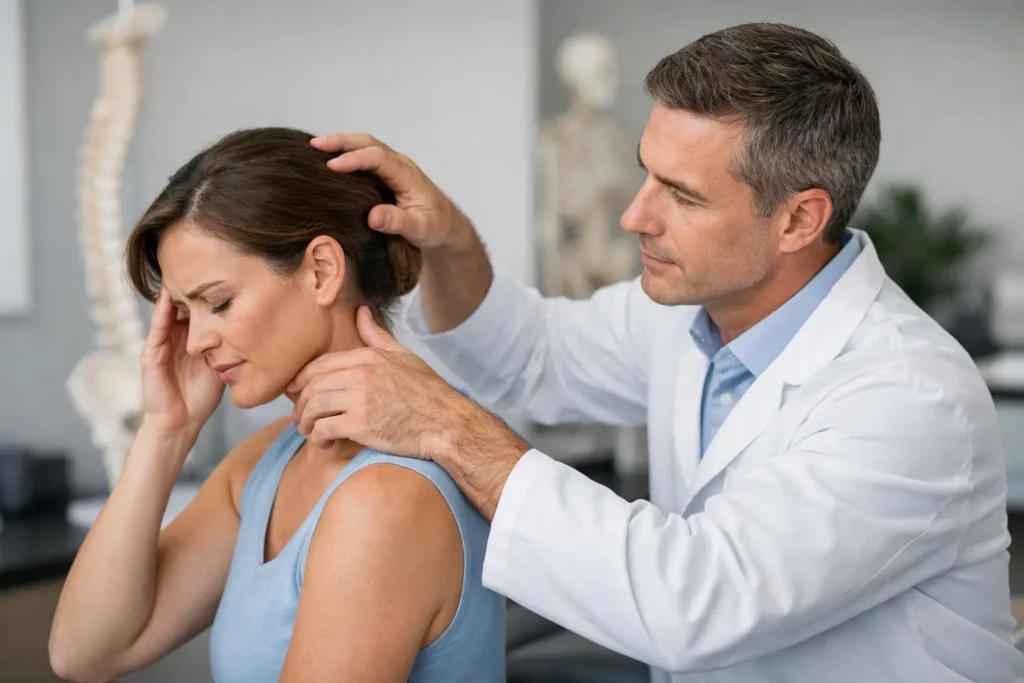
A tension headache often feels like a tight band across the forehead, pressure at the temples, or a dull ache that starts at the base of the skull after a long day. For many people, the discomfort is not only in the head. It is connected to persistent neck stiffness, shoulder tension, jaw clenching, restricted movement, or the physical demands of work and daily life.
Understanding how manual medicine treats tension headaches begins with a different question: what is repeatedly loading the tissues and pain-sensitive structures around the head and neck? A thoughtful neuromusculoskeletal evaluation looks beyond the location of the headache to identify the movement, muscle, joint, nerve, and postural factors that may be contributing to it.
Tension Headaches Are Often More Than “Stress Headaches”
Stress can certainly amplify tension-type headaches. It can increase muscle guarding, reduce sleep quality, and make the nervous system more sensitive to normal physical input. But stress alone does not explain why one person develops recurring head pain while another does not.
The neck, upper back, shoulders, and jaw work together throughout the day. When movement is restricted or certain muscles are asked to do too much for too long, the body may develop a pattern of overload. Tight or fatigued muscles near the base of the skull can refer pain upward. Stiff cervical joints may alter how the neck moves. Forward-head work positions, prolonged screen use, repetitive driving, previous injuries, and poor sleep positioning can all add to the problem.
In some cases, a person labeled as having tension headaches may have a different or overlapping condition, such as migraine, cervicogenic headache, medication-overuse headache, or pain referred from the jaw. That distinction matters because the most useful treatment plan depends on an accurate diagnosis.
How Manual Medicine Treats Tension Headaches at Their Source
Manual medicine is not a single technique. It is a physician-guided approach that uses skilled hands-on examination and treatment as part of a broader clinical plan. The goal is not simply to make a tight muscle feel looser for a few hours. It is to identify the physical contributors to headache patterns and improve the way the involved areas move, tolerate load, and coordinate.
During treatment, a physician may use carefully selected hands-on methods to address restricted motion in the neck or upper back, reduce guarding in overloaded muscles, and improve the mobility of tissues that may be contributing to pain. Treatment may focus on the upper cervical region, the junction between the neck and upper back, the shoulder girdle, or the jaw when the examination indicates those structures are involved.
The approach should be precise and appropriate to the individual. A patient with generalized muscle sensitivity and poor sleep may need a different plan than someone whose headaches reliably begin after looking down at a laptop or turning the head during long drives. Hands-on care is most valuable when it follows a clear clinical explanation rather than a routine protocol.
Restoring Motion Without Forcing It
Pain often leads people to brace and limit movement. Over time, that protective pattern can make the neck feel more rigid and can shift work into smaller, easily fatigued muscles. Gentle, targeted manual treatment may help reduce this guarding and improve comfortable movement.
That does not mean every stiff area should be treated aggressively. Some people have joint irritation, hypermobility, inflammatory conditions, osteoporosis, prior surgery, or other factors that change what is appropriate. A specialty evaluation helps determine which techniques are suitable and which should be avoided.
Addressing Muscle Overload and Triggered Pain Patterns
The small muscles beneath the skull, the upper trapezius, levator scapulae, and jaw muscles can all participate in tension-type headache patterns. When these muscles remain active for prolonged periods, they may become tender and can reproduce familiar head pain when examined.
Manual treatment may reduce local tenderness and improve tissue mobility, but durable progress usually requires addressing why the muscles are overworking. This may involve improving neck and shoulder mechanics, adjusting daily movement habits, addressing jaw clenching, or building endurance in the muscles that support the head and upper body.
Considering Nerve Sensitivity and Referred Pain
Headache pain is not always generated where it is felt. Sensory pathways from the upper neck share connections with pathways that transmit pain from the head and face. This is one reason a neck problem can be felt as pain behind the eyes, across the forehead, or around the temples.
A physician trained in Neuromusculoskeletal Medicine evaluates whether the pattern is consistent with referred pain from cervical structures, irritation of occipital nerves, muscle-generated pain, or another headache disorder. This step is particularly helpful for patients whose imaging has not provided a clear answer or whose symptoms have persisted despite medication, therapy, or other conventional care.
A Thorough Evaluation Comes Before Treatment
Effective manual medicine begins with listening carefully to the history. The timing, location, duration, intensity, and triggers of headaches provide meaningful diagnostic information. So do associated symptoms such as nausea, light sensitivity, visual changes, dizziness, numbness, jaw pain, sleep disruption, or pain radiating into the shoulder or arm.
The physical examination then assesses posture, cervical range of motion, joint mobility, muscle tenderness, shoulder function, neurologic findings, and the way symptoms respond to specific movements or positions. The purpose is not to blame posture or find one isolated “misalignment.” It is to understand the patient’s overall movement pattern and identify the structures most likely contributing to symptoms.
Imaging, laboratory studies, or referral may be appropriate in selected cases. Many common tension headaches do not require extensive testing, but a clinician should not assume that every recurring headache is benign or mechanical.
Manual Treatment Works Best as Part of an Individualized Plan
For recurring headaches, hands-on care is often one component of treatment rather than the entire answer. A well-designed plan may also include specific mobility or strengthening exercises, strategies to improve workstation tolerance, pacing of aggravating activities, sleep-position guidance, and coordination with other appropriate medical care.
The trade-off is that this approach requires participation and reassessment. Passive treatment can provide useful symptom relief, but lasting improvement usually depends on changing the forces that keep reactivating the problem. A patient who has headaches after eight hours at a computer may need both targeted treatment and a practical plan for breaks, screen position, neck endurance, and shoulder support.
Progress should be measured. This includes headache frequency, duration, severity, medication use, ability to work or exercise, sleep quality, and neck function. If a treatment is not producing meaningful change, the diagnosis and plan should be reconsidered rather than simply repeating the same intervention.
When a Headache Needs Urgent Medical Attention
Most tension-type headaches are not emergencies, but certain symptoms need prompt medical assessment. Seek urgent care for a sudden, severe headache that reaches maximum intensity quickly, especially if it is unlike previous headaches. Immediate evaluation is also important when headache occurs with confusion, fainting, seizure, weakness, difficulty speaking, new vision loss, fever and neck stiffness, or after significant head trauma.
New headaches after age 50, headaches that are progressively worsening, or headaches associated with cancer, immune suppression, pregnancy, or major unexplained weight loss also deserve careful medical review. Manual treatment should never delay evaluation of warning signs.
When Specialty Evaluation May Help
A specialty neuromusculoskeletal evaluation may be useful when headaches keep returning despite usual treatment, when neck pain or restricted motion is clearly part of the pattern, or when the diagnosis remains uncertain. It can also help patients who have completed therapy or tried medication but still do not understand why their symptoms persist.
At Prather Neuromusculoskeletal Medicine, the focus is on careful physician-level analysis of the head, neck, spine, nerves, and movement system. The aim is to clarify the problem, identify reasonable non-surgical options, and develop a plan that matches the patient rather than a generic headache protocol.
Recurring headaches deserve more than repeated temporary relief. If you would like to determine whether your case is appropriate for specialty evaluation, schedule a complimentary Virtual Consultation – Case Evaluation with Dr. Eric Prather. Call 337-984-3113 or book online at www.prathernmsk.com. A clear diagnosis and a thoughtful plan can be an important next step toward more comfortable movement and more predictable days.