A meaningful orthopedic decompression therapy review should begin with a more useful question than, “Does it work?” The better question is: “Does this treatment fit the actual source of my pain and the way my spine, nerves, and movement are functioning?” For the right patient, decompression may be a reasonable part of a non-surgical plan. For the wrong diagnosis, it can consume time and resources without addressing the problem that is truly limiting function.
Many people considering decompression therapy have already tried medication, physical therapy, injections, or other conservative care. Some have been told they have a disc problem or spinal stenosis. Others simply know that back pain, leg pain, numbness, or neck symptoms are disrupting work, sleep, and daily life. Those symptoms deserve a careful clinical explanation before any treatment is selected.
What orthopedic decompression therapy is
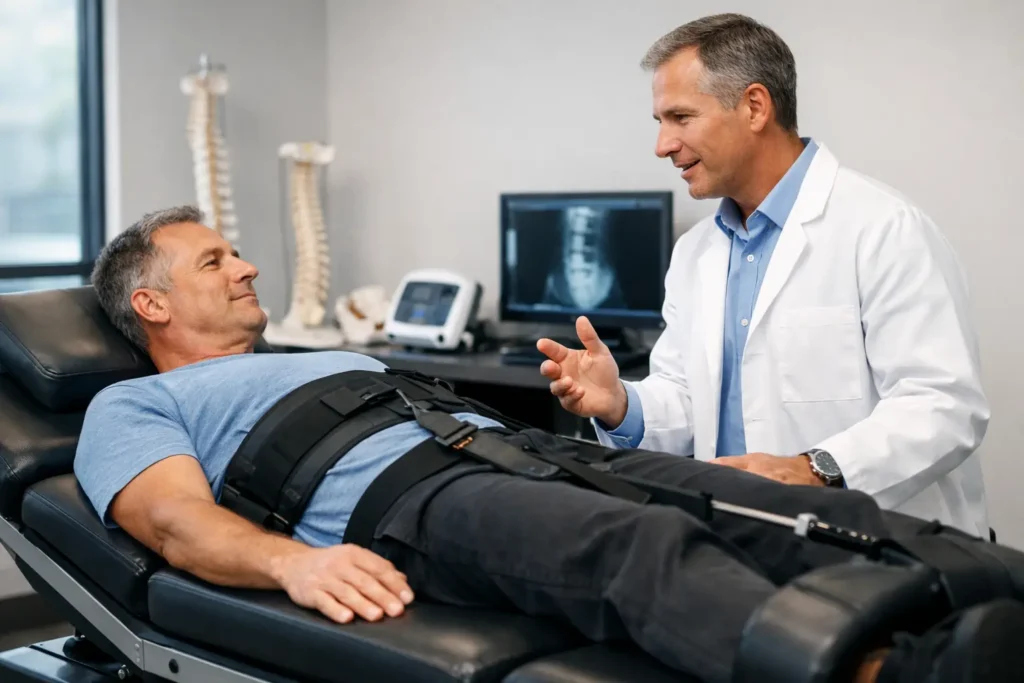
Non-surgical orthopedic decompression therapy generally uses a computerized traction table to apply controlled pulling forces to the spine. The goal is to reduce compressive loading across spinal joints and discs for a period of time. Depending on the equipment and treatment plan, the patient may lie on the back or stomach while the table applies gentle, measured traction.
The proposed benefit is not that a machine “puts a disc back in place.” Spinal pain is rarely that simple. Instead, traction may temporarily alter pressure and mechanical stress around irritated tissues. In selected cases, that reduction in load can make movement more tolerable, calm pain sensitivity, and create an opportunity to progress with rehabilitation.
Decompression is most often discussed for lumbar conditions involving low back pain with leg symptoms, including certain disc-related presentations. It may also be used for cervical complaints in some settings. The appropriate region, force, position, duration, and frequency should be based on the patient’s findings, not on a standard package of visits.
What a credible orthopedic decompression therapy review should examine
Online reviews often focus on comfort, office experience, or whether someone felt better after several sessions. Those details matter, but they do not tell the full clinical story. A sound review considers diagnosis, safety, measurable progress, and whether decompression is being used as part of a broader strategy.
The diagnosis matters more than the machine
Low back pain can originate from discs, facet joints, the sacroiliac region, hip disorders, muscles, peripheral nerves, or a combination of these factors. Leg pain is not automatically sciatica, and an MRI finding does not automatically explain symptoms. Disc bulges and degenerative changes are common, including in people without pain.
A physician-level neuromusculoskeletal evaluation connects the history, physical examination, movement pattern, neurologic findings, and imaging when appropriate. This process helps determine whether the symptoms are consistent with nerve-root irritation, mechanical disc pain, spinal stenosis, hip referral, or another source.
If the primary driver is not responsive to traction, decompression is unlikely to be the answer. If multiple contributors are present, decompression alone may be too narrow a treatment approach.
Evidence is mixed and patient selection is essential
The research on spinal traction and computerized decompression is mixed. Some patients report meaningful relief, while studies have not consistently shown broad, predictable benefit across every type of back or neck pain. This does not mean decompression has no role. It means it should not be presented as a universal treatment or a substitute for diagnosis.
In clinical practice, a therapy can be reasonable when it is low risk for an appropriate patient, has a clear therapeutic rationale, and is monitored against objective goals. The question is not whether every patient improves. The question is whether this specific patient is showing progress in pain, walking tolerance, sitting tolerance, sleep, neurologic symptoms, and function.
A short, structured trial may be appropriate in selected cases. If there is no meaningful change, the plan should be reconsidered rather than simply repeating the same treatment indefinitely.
Decompression should support active recovery
Even when decompression reduces symptoms, it does not replace rehabilitation. Pain often develops in the context of altered movement, guarding, reduced strength, poor load tolerance, or nerve sensitivity. As symptoms improve, a patient typically needs a plan to restore confidence and capacity through individualized movement, targeted exercise, and practical modification of aggravating activities.
This is especially relevant for patients who feel better lying down but struggle when returning to work, lifting, driving, or prolonged standing. The goal is not merely a temporary reduction in discomfort after a session. The goal is improved function in real life.
Who may be a reasonable candidate?
A patient may be considered for non-surgical decompression when symptoms and examination findings suggest a mechanical spinal condition that could reasonably respond to temporary unloading. This may include selected disc-related low back pain, pain radiating into the leg, or symptoms aggravated by spinal compression and improved by certain positions.
The strongest candidates are not identified by an advertisement or imaging report alone. They are identified through a pattern of findings. For example, a patient with low back pain, leg symptoms in a consistent nerve distribution, a compatible examination, and no concerning neurologic decline may warrant a carefully monitored non-surgical plan that includes decompression.
However, it depends. A person with pain mainly arising from a hip condition, severe movement dysfunction, sensitized nerves unrelated to spinal compression, or advanced structural instability may need a different approach. The same is true for patients whose pain is present but whose main limitation is weakness, balance loss, or progressive numbness.
When decompression may not be appropriate
Decompression therapy is not appropriate for every spine condition. It may be avoided or require additional medical clearance in the presence of fracture, significant osteoporosis, spinal infection, cancer involving the spine, certain types of instability, recent surgery, or severe and progressive neurologic deficits. Pregnancy, implanted devices, vascular concerns, and other health conditions can also affect candidacy.
New bowel or bladder changes, saddle numbness, rapidly worsening weakness, unexplained fever, major trauma, or severe unrelenting pain require prompt medical assessment rather than a routine decompression appointment. These symptoms do not automatically indicate an emergency, but they should be evaluated carefully and without delay.
Patients considering surgery should also understand that decompression is not a way to avoid a necessary surgical opinion. Some conditions require surgical evaluation because of progressive neurologic loss or structural problems that cannot be responsibly managed with conservative treatment alone. A comprehensive non-surgical evaluation can still be valuable in clarifying options and determining whether surgery is truly indicated.
Questions to ask before starting treatment
Before committing to a course of care, ask what diagnosis is being treated and what examination findings support it. Ask how improvement will be measured beyond a pain score. A thoughtful plan should identify functional goals, such as walking farther, sitting through a workday, sleeping more comfortably, or returning to a specific activity.
Also ask what will happen if treatment does not help. A clinician should be able to explain when the plan will be adjusted, when additional testing may be appropriate, and when another type of treatment or specialist referral should be considered. Clear answers reflect clinical reasoning, not a one-size-fits-all protocol.
A specialty perspective on persistent spine pain
For patients with difficult or persistent symptoms, the central issue is often not whether decompression therapy is good or bad. It is whether the current diagnosis and treatment plan are sufficiently precise. Pain can improve temporarily with many interventions, yet continue to return when the underlying mechanical, neurologic, or movement-related contributors have not been identified.
At Prather Neuromusculoskeletal Medicine, non-surgical orthopedic decompression is considered within a broader physician-guided strategy. The focus is on determining the true source of symptoms, assessing the role of the spine and nerves, and using treatments that fit the patient’s condition, goals, and response over time. For some patients, decompression may be useful. For others, a different path is more appropriate.
If you have persistent back, neck, joint, or nerve symptoms, have not improved with prior care, or want a careful non-surgical opinion before considering surgery, schedule a complimentary Virtual Consultation – Case Evaluation with Dr. Eric Prather. Call 337-984-3113 or book online at www.prathernmsk.com to determine whether your case is appropriate for specialty evaluation. The most productive next step is often not another generic treatment, but a clear explanation of what your body is signaling and what should be addressed next.