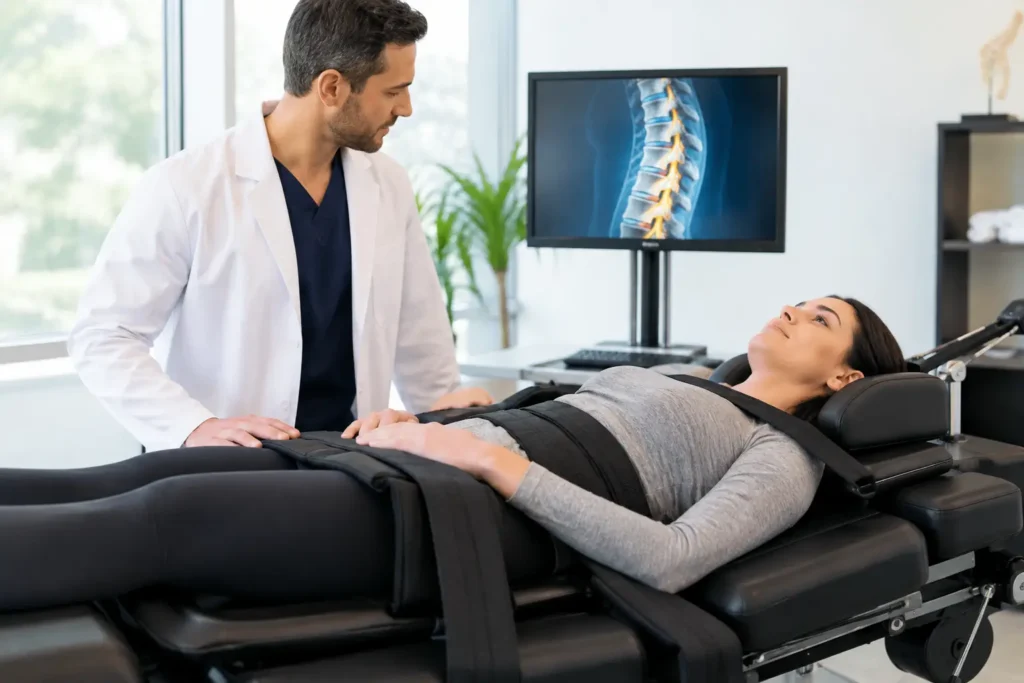
A nerve can be irritated long before an MRI report or X-ray explains the full story. Pain traveling into an arm or leg, numbness, tingling, burning, or a feeling of weakness may reflect pressure on a nerve, but pressure is only one possible contributor. Understanding how spinal decompression helps nerves begins with identifying exactly where the nerve is affected, what is creating the irritation, and whether decompression is appropriate for that specific condition.
At Prather Neuromusculoskeletal Medicine, this distinction matters. Patients with persistent spine and nerve symptoms often arrive after therapy, medications, injections, or other treatment has provided limited relief. A careful physician-level neuromusculoskeletal evaluation can clarify whether the symptoms truly arise from the spine, from a peripheral nerve outside the spine, from a joint or muscle problem, or from more than one source.
What nerve compression in the spine means
The spinal cord and spinal nerves travel through protected spaces formed by the vertebrae. At each level of the spine, nerve roots exit through openings called foramina. These nerves carry signals for sensation and movement to the neck, shoulders, arms, back, hips, and legs.
A nerve may become irritated when the available space around it narrows or when nearby tissue becomes inflamed. Common causes include a disc bulge or herniation, arthritic changes in the facet joints, thickening of supporting ligaments, spinal stenosis, or vertebral slippage. In the neck, this can contribute to radiating arm symptoms. In the lower back, it may contribute to sciatica-like pain, leg numbness, or symptoms that worsen with standing or walking.
However, imaging findings do not automatically identify the pain source. Many adults have disc changes or narrowing without symptoms. Conversely, a person may have significant symptoms with imaging that appears only mildly abnormal. The relevant question is whether the examination, symptom pattern, functional limitations, and imaging all point to the same nerve pathway.
How spinal decompression helps nerves
Spinal decompression is a broad term. It may refer to surgical procedures that remove tissue restricting a nerve, or to carefully selected non-surgical approaches designed to reduce mechanical irritation and improve tolerance to movement. The appropriate meaning depends on the diagnosis.
In non-surgical care, controlled spinal distraction or traction may temporarily increase space between vertebrae and reduce loading on sensitive structures. For a patient whose symptoms are linked to a disc-related nerve irritation, this change may reduce pressure or tension around the involved nerve root. It can also help some patients move more comfortably, which creates an opportunity to restore strength, walking tolerance, and confidence with daily activity.
The benefit is not simply that a machine “pulls the spine apart.” Nerves respond to their mechanical and inflammatory environment. When a nerve root is compressed, chemically irritated by disc material, or repeatedly stressed during certain positions, it may become more sensitive. A well-designed decompression strategy may reduce the aggravating mechanical load enough to calm symptoms and support rehabilitation.
That said, decompression does not repair every spinal change or guarantee relief. The response depends on the underlying diagnosis, severity of nerve involvement, duration of symptoms, overall health, and whether the treatment plan addresses contributing movement and loading problems. In many cases, decompression is one component of a broader non-surgical orthopedic plan rather than a stand-alone solution.
Reducing mechanical stress without forcing movement
For some patients, bending, sitting, standing upright, or extending the back predictably worsens radiating symptoms. A specialist may use positional testing to determine which movements increase or decrease nerve-related symptoms. This information is more useful than applying the same decompression protocol to everyone.
The goal is to reduce provocation, not to force a painful position. Treatment may involve a measured course of non-surgical orthopedic decompression, targeted movement strategies, progressive stabilization, and practical changes to sitting, lifting, walking, or work demands. The plan should evolve according to objective changes in pain distribution, sensory symptoms, strength, and function.
Supporting nerve recovery conditions
A nerve that has been irritated may remain sensitive after the original mechanical trigger improves. This is one reason symptoms do not always disappear immediately. The nervous system needs time and a more favorable environment to settle.
When decompression is appropriate, it may help by reducing the repeated stress that keeps the nerve reactive. Patients can then often tolerate the gradual return of normal motion and activity more effectively. The focus remains functional: sleeping more comfortably, walking farther, sitting with less leg pain, using the arm with less tingling, or returning to work tasks with greater control.
When decompression may be a reasonable option
Non-surgical decompression may be considered when symptoms and examination findings are consistent with a mechanical spine-related nerve problem, particularly when a patient has not improved sufficiently with more general care. It is often most useful when the clinical picture suggests that nerve irritation changes with posture or spinal loading.
For example, a person with lower back pain and pain extending below the knee may have a lumbar nerve root problem, but that pattern still requires evaluation. Hip disorders, sacroiliac conditions, peripheral nerve entrapments, vascular conditions, and other concerns can create overlapping symptoms. Treating presumed “sciatica” without confirming its source can lead to months of ineffective care.
Similarly, neck pain with arm tingling is not always caused by a cervical disc. Shoulder pathology, thoracic outlet-related conditions, and nerve compression farther down the arm may produce similar complaints. A detailed examination helps distinguish these possibilities and identify when decompression is likely to add value.
When decompression is not the right answer
Not every nerve symptom should be managed with spinal decompression. If symptoms are caused primarily by a peripheral nerve entrapment, a metabolic neuropathy, an inflammatory condition, or a non-spinal joint disorder, the treatment approach should address that source instead.
Some spine conditions also require more urgent medical or surgical assessment. Progressive weakness, significant loss of coordination, new bowel or bladder changes, saddle-area numbness, fever with severe back pain, or symptoms following major trauma warrant prompt evaluation. These signs do not mean that surgery is inevitable, but they should not be managed by routine decompression alone.
There are also situations where surgery may be the most appropriate recommendation, such as severe or progressive neurologic loss or structural compression that is unlikely to respond to conservative measures. A thorough non-surgical evaluation should not delay necessary care. Its purpose is to make a well-reasoned decision, including recognizing when a different level of intervention is needed.
Why a precise evaluation comes first
The most valuable question is not, “Do I need decompression?” It is, “What is causing my symptoms, and what treatment best fits that cause?” This requires more than reviewing an imaging report.
A comprehensive neuromusculoskeletal evaluation considers symptom behavior, posture, gait, joint motion, muscle control, neurologic findings, prior treatment response, and imaging in clinical context. Strength testing and reflexes can identify patterns consistent with nerve root involvement. Sensory changes may help localize a problem, while movement testing can show whether a particular spinal position changes symptoms. When appropriate, additional diagnostic information may be needed before designing treatment.
This level of analysis is particularly important for patients with complex or long-standing pain. A person may have more than one contributing issue: a lumbar nerve irritation plus hip stiffness, or cervical narrowing plus shoulder dysfunction. Treating only the most visible finding may not restore the function the patient wants.
A thoughtful path forward for persistent nerve symptoms
Nerve-related pain can be frustrating because it affects more than comfort. It can interrupt sleep, limit work, reduce walking tolerance, and make ordinary movements feel uncertain. Yet persistent symptoms do not automatically mean that surgery is the only remaining option.
A precise diagnosis can reveal non-surgical options that were not apparent when care was focused only on the painful area or a single MRI finding. For selected patients, spinal decompression may be a meaningful part of a broader strategy to reduce nerve irritation and restore function. For others, a different treatment direction will be more appropriate. The difference is careful clinical reasoning.
If you have ongoing spine, arm, leg, numbness, tingling, or nerve-related symptoms and want an expert assessment before making your next decision, schedule a complimentary Virtual Consultation – Case Evaluation with Dr. Eric Prather. Call 337-984-3113 or book online at www.prathernmsk.com to determine whether your case is appropriate for specialty evaluation.