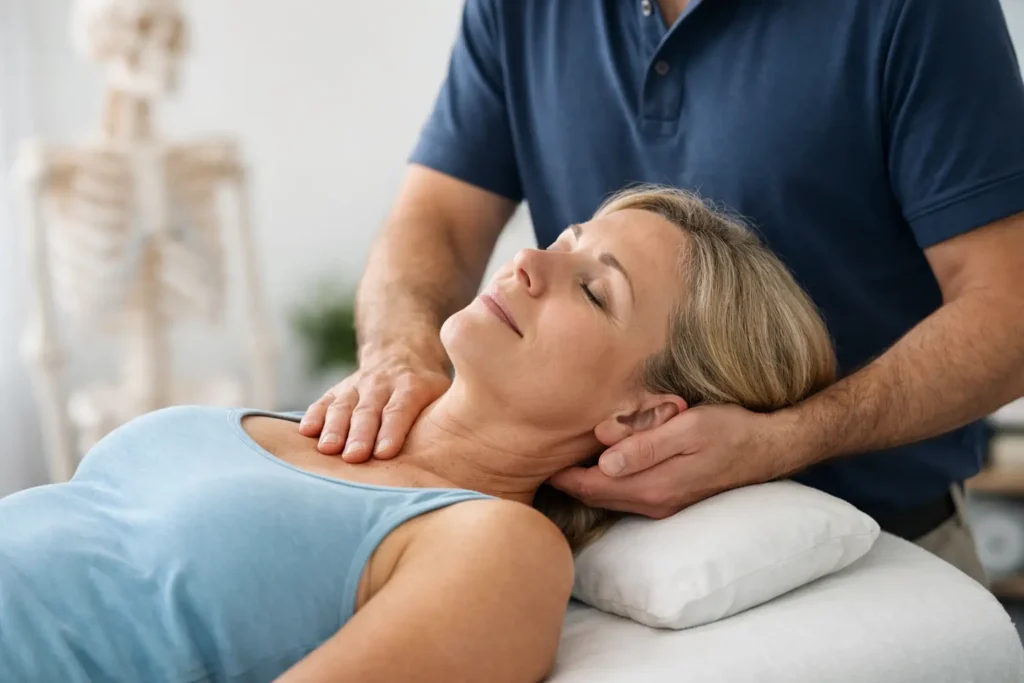
Pain rarely starts as a simple problem. A patient may point to the low back, neck, shoulder, or hip, but the real issue is often a mix of joint restriction, muscle guarding, irritated nerves, inflamed soft tissue, and altered movement patterns. That is why the question, how does manual therapy reduce pain, matters so much. When treatment is applied with the right diagnosis, skilled hands can change the mechanics that are feeding the pain in the first place.
Manual therapy is not just rubbing a sore area or forcing a joint to move. In a clinical Neuromusculoskeletal Medicine setting, it is a targeted hands-on treatment used to improve motion, reduce tissue tension, decrease nerve irritation, and restore more normal function. The goal is not to temporarily distract the brain from discomfort. The goal is to address the physical dysfunction contributing to the symptoms.
How does manual therapy reduce pain in the body?
The short answer is that manual therapy reduces pain by changing what is happening in the joints, muscles, fascia, and nervous system. Pain often increases when a joint is compressed, when surrounding muscles tighten to protect the area, or when nerves become irritated by poor alignment or inflammation. Hands-on treatment can reduce these stressors and give the body a better mechanical environment for healing.
That response is both local and neurological. Locally, manual treatment may improve joint glide, reduce myofascial restriction, and decrease pressure in tissues that are not moving well. Neurologically, it can calm pain-sensitive structures and reduce the protective muscle spasm that often keeps a problem going long after the initial injury.
This is one reason the same pain diagnosis can feel very different from one patient to another. Two people may both have neck pain, but one is dealing mostly with muscle hypertonicity while the other has disc-related compression or nerve irritation. Manual therapy can help both, but the technique, force, and treatment plan should be different.
Pain is often mechanical before it becomes constant
Many painful conditions begin with a mechanical fault. A spinal segment may lose normal motion. A shoulder may start moving with poor joint mechanics. A hip may become restricted, forcing the low back to compensate. At first, the pain may come and go. Over time, the body adapts in a way that creates more strain.
When motion is reduced, surrounding muscles usually try to stabilize the region. That sounds helpful, but prolonged guarding can become part of the problem. Tight muscles compress joints, pull on irritated tissue, and reduce circulation. Patients often describe this as stiffness, locking, tension, or a feeling that something is constantly pulling.
Manual therapy can interrupt that cycle. By improving mobility in restricted segments and reducing abnormal tissue tension, it may lessen the force being transferred into already sensitive structures. In practical terms, that can mean less pain with sitting, walking, bending, lifting, or turning the head.
Joint motion changes pain signals
Healthy joints are meant to move in controlled ways. When they do not, stress is shifted to adjacent tissues. A restricted spinal joint may increase demand on discs, ligaments, and muscles. A stiff rib cage may contribute to neck and upper back pain. A poorly moving ankle can even affect the knee and hip.
Manual joint mobilization or manipulation can restore more normal movement and reduce pain generated by these dysfunctional mechanics. It may also stimulate joint receptors that influence how the nervous system processes pain. This is one reason some patients feel relief almost immediately after treatment, even before tissue healing has fully occurred.
Immediate relief is valuable, but it is not the only measure of success. In more complex cases, the benefit builds over time as repeated treatment reduces joint stress and helps the patient move better between visits.
Soft tissue treatment reduces protective guarding
Muscles often become overactive around an injured or irritated area. This guarding is a protective response, but when it persists, it can amplify pain. Trigger points, fascial restriction, and shortened tissue can all contribute to limited range of motion and ongoing discomfort.
Soft tissue manual therapy may reduce that guarding by decreasing muscle tone, improving circulation, and allowing tissue to lengthen more normally. Patients frequently notice that the treated area feels lighter, looser, or less inflamed after care. That is not just a comfort effect. Better tissue mobility can reduce strain on tendons, nerves, and joints.
The result is often improved movement quality. When the body no longer has to fight through tension at every step, pain during daily activity may begin to decrease.
How does manual therapy reduce pain when nerves are involved?
Nerve-related pain is one of the most common reasons patients seek advanced manual care. This can include radiating pain, tingling, numbness, burning, or sharp pain into the arms or legs. In these cases, the goal is not simply to treat the area where symptoms are felt. It is to reduce the mechanical irritation affecting the nerve.
That may mean improving spinal motion, reducing local inflammation, decreasing muscle tension around the nerve pathway, or using decompressive strategies to reduce pressure on involved structures. In carefully selected patients, manual therapy can help create more space and less stress around the affected area.
This is where proper diagnosis matters. Nerve symptoms are not all the same. A pinched nerve in the neck, disc-related irritation in the low back, and peripheral nerve entrapment each require different clinical reasoning. The wrong force, wrong direction, or wrong frequency of treatment can aggravate symptoms instead of helping.
That is why a specialized examination is so important before beginning care. Pain relief is best achieved when treatment matches the exact source and pattern of dysfunction.
Manual therapy works with the nervous system, not against it
Pain is not produced only by damaged tissue. It is also shaped by the nervous system. When an area has been painful for weeks or months, the body can become more reactive. Normal movement starts to feel threatening. Muscles tighten faster. Pain signals become easier to trigger.
Hands-on treatment can help by providing controlled, therapeutic input to the nervous system. When a restricted area begins to move better and tissue tension decreases, the brain receives new information that the area may be safer to use. This can reduce guarding and improve confidence with movement.
That does not mean all chronic pain can be fixed with manual therapy alone. Some patients also need corrective exercise, decompression, imaging, co-management, or additional medical evaluation. But when biomechanical dysfunction is part of the pain pattern, manual medicine is often an important part of the solution.
Why treatment is not one-size-fits-all
The phrase manual therapy covers a broad range of techniques. Some involve precise joint manipulation. Others use slower mobilization, myofascial release, muscle energy techniques, or targeted soft tissue work. The best choice depends on the diagnosis, symptom severity, age, tissue health, and patient tolerance.
For example, an athletic adult with acute thoracic restriction may respond well to a more direct adjustment. An older patient with degenerative change, chronic guarding, and nerve sensitivity may need a gentler, progressive approach. A patient after an auto accident may need treatment that accounts for soft tissue injury, inflammation, and post-traumatic muscle spasm rather than forceful correction.
This is one of the biggest differences between generalized pain treatment and a specialist-driven approach. The question is not whether manual therapy helps in the abstract. The question is which manual therapy, applied where, how often, and in combination with what other care.
What patients usually notice first
Most patients do not describe their improvement in technical language. They say they can turn their head without catching. They can stand up straighter. Their arm stops going numb at night. The low back does not seize when they get out of the car. They feel less pressure, less stiffness, and more control over their movement.
Those changes matter because pain relief is only part of recovery. Better motion usually leads to better function, and better function is what allows patients to work, sleep, exercise, and return to normal life with less dependence on medication.
At Prather Neuromusculoskeletal Medicine, that is the value of a careful, hands-on, diagnostics-driven approach. Manual therapy is not used as a routine habit. It is used as a focused treatment for patients whose pain is being sustained by mechanical and neuromusculoskeletal dysfunction.
If you have been living with pain that feels persistent, compressive, or resistant to routine care, the next step is not guessing. It is finding out what is truly driving the problem, because the right hands-on treatment can change more than pain levels – it can change how your body moves and heals.