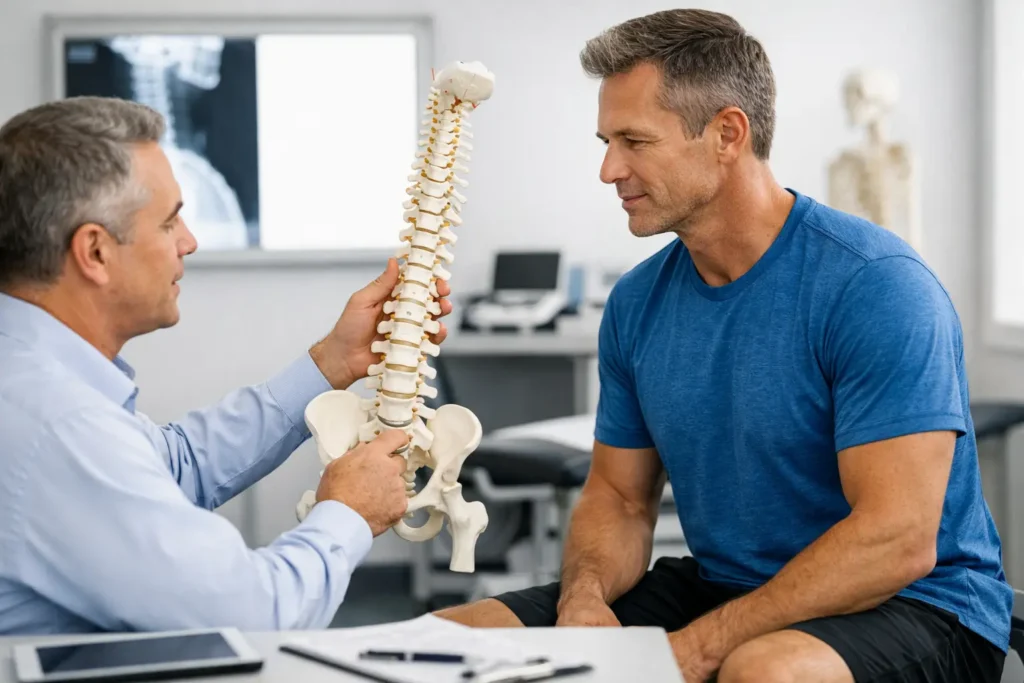
A scan may say “disc compression,” but that phrase alone rarely explains why one person has manageable back stiffness while another has burning leg pain, numbness, weakness, or difficulty walking. The best treatments for disc compression begin by identifying exactly what is being compressed, where it is occurring, and whether the disc finding is truly responsible for the symptoms.
Disc-related conditions are common, and imaging findings such as bulging discs, herniations, narrowing, and degeneration become more frequent with age. Yet an MRI is only one piece of the clinical picture. Effective care requires correlating imaging with a detailed history, movement examination, neurologic findings, and the way symptoms behave during daily activity.
What “Disc Compression” Can Mean
Spinal discs are cushions between the bones of the spine. They help distribute load and permit movement. A disc can lose height, bulge outward, develop a tear, or herniate. Any of these changes may reduce the available space around a spinal nerve or contribute to narrowing of the spinal canal.
The location matters. In the neck, disc compression may contribute to neck pain, shoulder blade pain, arm pain, hand numbness, or weakness. In the low back, it may be associated with pain into the buttock, thigh, calf, or foot. Symptoms can also arise from joints, muscles, ligaments, hip disorders, peripheral nerve entrapment, or sensitization of the nervous system. This is why treating a scan instead of treating the patient often leads to disappointing results.
A compressed nerve does not always require surgery, and a disc abnormality does not always cause pain. The relevant question is whether the clinical findings support a meaningful disc and nerve problem that can be addressed with a specific treatment strategy.
The Best Treatments for Disc Compression Depend on the Cause
There is no single best treatment for every disc problem. The right approach depends on the severity and duration of symptoms, neurologic status, functional limitations, the level of the spine involved, and prior treatment response. A patient with a recent lumbar disc herniation and leg pain needs a different plan than someone with long-standing spinal narrowing, recurrent symptoms, and weakness.
Physician-Level Neuromusculoskeletal Evaluation
For persistent, recurrent, or unclear symptoms, a comprehensive evaluation is often the most valuable first step. This includes a careful review of symptoms, prior imaging and treatment records, posture and movement patterns, strength, reflexes, sensation, gait, and provocative testing. The goal is not simply to confirm a disc finding. It is to determine whether the disc is the main pain generator, whether a spinal nerve is affected, and whether another condition is contributing.
This evaluation also helps identify when imaging needs to be reviewed differently or when additional testing may be appropriate. An MRI can show anatomy, but it cannot measure every source of pain or explain how the body is functioning under load.
Activity Modification and Guided Movement
Complete bed rest is generally not the answer for most disc-related conditions. Prolonged inactivity can increase stiffness, reduce conditioning, and make return to normal activity more difficult. However, pushing through severe radiating pain or progressive weakness is not a sensible plan either.
A thoughtful approach temporarily modifies the movements and positions that repeatedly aggravate symptoms while preserving safe activity. For one person, prolonged sitting and bending may be the primary aggravators. For another, standing, walking, or extension of the spine may be more limiting. The treatment plan should reflect that pattern rather than applying generic exercises.
Guided rehabilitation can improve mobility, trunk and hip control, tolerance for daily activities, and confidence with movement. The most appropriate program is individualized and progressed according to symptom behavior and measurable function. If an exercise repeatedly causes pain to travel farther down an arm or leg, that is useful clinical information, not something to ignore.
Medication as a Limited Support Tool
Anti-inflammatory medication, acetaminophen, or certain nerve-pain medications may be appropriate for some patients. These treatments can reduce symptoms enough to allow sleep, movement, and participation in rehabilitation. Their role is usually supportive rather than curative.
Medication decisions should account for medical history, kidney and gastrointestinal risk, blood pressure, sedation, drug interactions, and the actual pattern of symptoms. Opioid medication is generally not a long-term solution for disc compression and can create additional complications. A careful plan aims to use the least medication necessary while addressing the underlying mechanical and neurologic factors.
Targeted Interventional Procedures
When substantial radiating pain persists despite appropriate conservative care, a targeted spinal injection may be considered. Depending on the diagnosis, an epidural or selective nerve-root procedure can reduce inflammation around an irritated nerve and provide a clearer understanding of the pain source.
An injection should have a defined clinical purpose. It may help a patient participate more effectively in rehabilitation, manage an acute flare, or clarify whether a particular nerve level is relevant. It is not automatically the next step for every abnormal MRI, and repeated procedures without a clear rationale deserve reassessment.
Non-Surgical Orthopedic Decompression and Specialized Care
Some patients may be candidates for specialized non-surgical approaches designed to improve tolerance to spinal loading, address movement dysfunction, and reduce nerve irritation. Non-Surgical Orthopedic Decompression may be considered as part of a broader plan for selected patients, particularly when symptoms, examination findings, and imaging support its use.
Appropriateness matters. Decompression is not a universal answer for every disc bulge, chronic back pain presentation, or severe neurologic condition. The best results come from selecting patients carefully and combining treatment with a physician-guided strategy that addresses mobility, stability, nerve involvement, daily loading habits, and functional goals.
When Surgical Consultation Is Appropriate
Surgery can be a reasonable and necessary option in certain situations. Progressive muscle weakness, significant neurologic loss, severe persistent leg or arm symptoms that do not respond to well-directed non-surgical care, or structural problems causing substantial disability may warrant surgical evaluation.
Urgent medical evaluation is needed for new bowel or bladder control problems, numbness in the groin or saddle region, rapidly progressing weakness, major balance changes, fever with severe spinal pain, or pain after significant trauma. These symptoms are not situations to manage through home exercises alone.
For many patients, the decision is not simply “surgery or nothing.” A thorough specialty evaluation can clarify whether there are reasonable non-surgical options to consider, whether surgery is likely to address the actual pain generator, and what functional goals should guide the decision.
Why Previous Treatment Sometimes Fails
Many patients have already completed physical therapy, tried medication, received injections, or been advised to consider surgery. Limited improvement does not necessarily mean the condition is untreatable. It may mean the diagnosis was incomplete, multiple pain sources were present, the rehabilitation plan was not matched to the patient’s mechanical pattern, or a nerve issue was not fully characterized.
Complex cases benefit from stepping back rather than simply repeating the same treatment. A precise diagnosis can prevent unnecessary procedures and focus care on the factors most likely to affect pain, mobility, work capacity, sleep, and participation in family life.
At Prather Neuromusculoskeletal Medicine, the emphasis is on comprehensive physician-level analysis for patients seeking clarity after persistent spine, nerve, and musculoskeletal symptoms. The objective is a personalized, evidence-informed plan that respects both the anatomy shown on imaging and the person living with the condition.
If disc compression is limiting your work, sleep, mobility, or confidence in movement, you do not have to make decisions based on an MRI report alone. Schedule a complimentary Virtual Consultation – Case Evaluation with Dr. Eric Prather by calling 337-984-3113 or booking online at www.prathernmsk.com to determine whether your case is appropriate for specialty evaluation. A careful assessment can help bring the next decision into clearer focus.